Revelation 1 opens with a distinctive blend of revelation, invitation, and authority. This chapter lays the groundwork for the entire book, presenting the risen Christ’s glory, the apostle John’s receptive spirit, and the structural design that governs the ensuing visions. In this article, you’ll find a verse-by-verse commentary that surveys the imagery, the theology, and the interpretive threads scholars have woven around these opening lines. The aim is to illuminate how Revelation 1 functions as both invitation and foundation for the apocalyptic material that follows, while also offering practical insight for readers today.
To understand the weight of Revelation 1, it helps to recall its context in Jewish, Greco-Roman, and early Christian thought. The book belongs to the genre of apocalyptic prophecy—not a simple chronological forecast but a vision-driven communication about God’s sovereignty over history, often conveyed through symbolic imagery. The opening insists on three pillars: divine authorship (the revelation comes from God and is mediated through Jesus Christ), audience specificity (the seven churches in Asia Minor), and urgent content (what must soon take place and what is to be read aloud and kept). The prologue is not a quiet preface but a regulatory frame: interpretive keys, literary symbolism, and pastoral instruction for communities facing pressure from imperial power, social change, and competing religious claims.
The phrase “the revelation of Jesus Christ” foregrounds Christ as the central subject of the book, not merely a subject of study but the one who discloses God’s purposes to humanity.
The line “which God gave him” emphasizes a threefold chain of custody—God the Father delegates to the Son, and the Son reveals to John for the church.
The recipients, the seven churches of Asia (modern-day western Turkey), anchor the book’s practical exhortations in particular local contexts while granting it a universal symbolic reach through the number seven.
Verse-by-Verse Explanation
Part I — The Prologue: 1:1–3
Verse 1: “The revelation of Jesus Christ, which God gave him to show his servants what must soon take place.” The verse introduces the core dynamic: revelation unfolds through Jesus Christ as mediator, given by God the Father, with the purpose of announcing imminent events. Urgency is a controlling tempo for the book: while “soon” has sparked debate about whether events were near in John’s era or overarching in divine timing, the insistence remains that readers should be prepared and attentive.
Verse 2: “Who bore witness to the word of God and to the testimony of Jesus Christ, even to all that he saw.” John’s role is twofold: he witnessed to the divine message and to the testimony of Jesus—a combined emphasis that the prophetic message and the Christ-centered message align. The verse foregrounds authentic eyewitness testimony as the trustworthy channel through which Revelation reaches its readers.
Verse 3: “Blessed is the one who reads aloud the words of this prophecy, and blessed are those who hear and who keep what is written.” This blessing anchors the entire book’s reception: literary activity (reading aloud), receptive practice (hearing), and obedient response (keeping or obeying the content). The verse also cautions that the time is near: the theological claim about immediacy calls readers to live in light of the coming revelation. In interpretive tradition, this triad—read, hear, keep—has served as a practical template for how churches engage with prophetic literature.
Part II — Greeting and Doxology: 1:4–8
Verse 4: “John to the seven churches that are in Asia: Grace to you and peace from him who is and who was and who is to come, and from the seven spirits who are before his throne.” The salutation locates the letter in a specific network (Asia Minor’s seven churches) while a cosmic frame aggregates the divine presence: the Father “who is and who was and who is to come” and the seven spirits before God’s throne. Scholarly debates often discuss who or what the “seven spirits” signify (completeness of the Spirit, fullness of God’s present action, or a symbolic liturgical reference). Theologically, this line asserts that the Christian proclamation is grounded in a triadic source of divine blessing—Father, Spirit, Son—even as the apostolic voice extends to the churches.
Verse 5–6: “and from Jesus Christ the faithful witness, the firstborn of the dead, and the ruler of kings on earth.” Jesus is described with three titles that foreground his cosmic authority and salvific role: (1) the faithful witness (mark of fidelity to God’s message), (2) the firstborn from the dead (preeminent victory over death), and (3) the ruler of the kings of the earth (sovereign over earthly powers). The results of his work—loved us, freed us from our sins by his blood, and made us a kingdom and priests—are not abstract but describe a transformed people who participate in his priestly and royal mission. This triad of Jesus’ status anchors the exhortations to the churches in a robust Christology, where salvation is enacted through Jesus’ faithful witness and his conquering over death.
Verse 7: “Behold, he is coming with the clouds, and every eye will see him, even those who pierced him…” The passage projects a future visibility that universalizes the revelation’s climactic moment: Christ’s return will be unmistakable and public. The piercing reference recalls the crucifixion and emphasizes the fulfillment of prophecy and judgment. This verse functions as both a comfort to believers and a warning to those who oppose God’s purposes, reinforcing the book’s dual dynamic of hope and accountability.
Verse 8: “I am the Alpha and the Omega,” says the Lord God, “who is and who was and who is to come, the Almighty.” The covenantal self-identification frames the entire book with divine sovereignty. The phrase Alpha and Omega is a Greek alphabetic seal of completeness and totality, signaling that God (and by emphasis, the divine plan) encompasses all beginnings and endings. In Revelation 1, this declaration primes readers for the further revelations that unfold under God’s authoritative governance, a theme carried forward through the visions that follow.
Part III — John’s Vision of the Risen Christ: 1:9–16
Verse 9: “I, John, your brother and fellow participant in the tribulation and the kingdom and the patient endurance that are in Jesus, was on the island called Patmos.” John situates his personal experience within the broader suffering, service, and steadfast hope of the church. Patmos is not merely geographic; it signals exile and witness under pressure. The phrase fellow participant with other believers marks intimate solidarity with the church under trial.
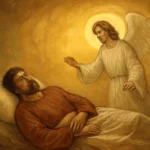
Verse 10: “I was in the Spirit on the Lord’s day, and I heard behind me a loud voice like a trumpet.” The sense of being in the Spirit indicates a trance-like or visionary state in which revelation becomes perceivable to the senses. The reference to the Lord’s day points to a liturgical or eschatological time frame when the church gathers in expectation of God’s action. The trumpet-like voice foreshadows authoritative communication and command.
Verse 11: “Saying, ‘Write what you see in a book and send it to the seven churches…’” The command anchors the rest of the narrative: John is to transcribe the visionary material as a missive to specific churches. The act of writing ensures permanence and dissemination; the content’s corporate address invites communal listening and obedience.
Verse 12–13: “Then I turned to see the voice that spoke with me.” And in the midst of the lampstands, someone stood—“one like a son of man”—clothed with a long robe and a golden sash. The phrase “one like a son of man” echoes Daniel’s prophetic figure, signaling a figure who embodies both humanity and divine authority. The surrounding imagery links Christ to priestly and kingly roles at the center of the cosmic drama.
Verse 14–16: The appearance details intensify: hair white like wool or snow, eyes—fiery like fire, feet like polished bronze, voice like many waters, and holding seven stars in his right hand, while standing among seven lampstands. The description is deliberately symbolic:
White hair connotes ancient wisdom and eternal purity.
Fiery eyes signify piercing insight and judgment.
Bronze feet imply steadfast strength and stability in judgment.
Voice like waters suggests powerful, life-giving speech that traverses barriers.
Seven stars and lampstands reinforce the imagery of divine oversight: the Son of Man holds the destiny of the churches and dwells among the ecclesial communities they symbolize.
Verse 16: “In his right hand he held seven stars, from his mouth issued a sharp two-edged sword, and his face was like the sun shining in full strength.” The sword denotes authoritative judgment, the radiant face denotes divine glory, and the stars in his hand emphasize his controlling power over the churches and their messengers. This is not mere spectacle; it is a theological statement about Christ’s supremacy over all powers and systems in the world.
Part IV — The Response and Explanation: 1:17–20
Verse 17: When John sees the vision, he falls at Christ’s feet as though dead, and Christ places his right hand on him saying, “Fear not.” The imperative to fear not is a common apocalyptic motif, inviting readers to approach divine revelation with reverent awe rather than paralyzing fear. The reassurance that the speaker gives—“I am the first and the last”— echoes the divine self-identification found in 1:8 and reinforces the unity between Father and Son in the one cosmic economy.
Verse 18: Christ declares, “I am the one who lives, and I was dead, and look, I am alive forevermore.” The motif of life gained through death—death’s defeat—underlines the certainty of victory over mortality. The additional claim, “I have the keys of Death and Hades,” communicates Christ’s decisive authority over the realm of the dead and the afterlife, a claim with immense pastoral and eschatological significance for early readers facing persecution and fear of oblivion.
Verse 19: “Write, therefore, what you have seen, what is now, and what will take place later.” This triadic sequencing provides a structural record for the book: content already seen, present realities to interpret, and future events to anticipate. The verse sets an interpretive grid for the next chapters, where John will report both current church circumstances and forthcoming visions of final fulfillment.
Verse 20: “The mystery of the seven stars that you saw in my right hand, and the seven lampstands is this: The seven stars are the angels of the seven churches, and the seven lampstands are the seven churches.” This closing explanatory note crystallizes the ambiguous imagery: stars = angels/messengers of the churches, lampstands = churches themselves. Interpreters debate whether “angels” are literal heavenly beings assigned to each church or symbolic guardians of gospel witness. Either way, the verse confirms that Christ’s care and governance extend over the church’s leadership (messengers) and its public witness (the lampstands). This dual mapping helps readers interpret prophetic symbolism in the chapters to come, where messages to each church address specific concerns while testing the broader dynamics of fidelity, compromiser, and endurance.
The opening chapter is thick with imagery that has generated extensive commentary. Here are some central symbolic themes and their typical interpretive payoffs:
Seven as completeness: The number seven frames imagery across Revelation (seven churches, seven spirits, seven lampstands, seven stars). In this chapter, it signals totality and divine completeness—God’s plan covers all congregations and all times.
Christology as the book’s hinge: The depiction of the risen, glorified Christ—one who lives, was dead, and is now alive forevermore—anchors every subsequent vision. The Son of Man stands as the authoritative interpreter of history and destiny for the church.
Priest-king imagery: The robe and golden sash, combined with the priestly language of holiness and the kingly authority implied by the stars and the sword, present Jesus as both priest and king, governing the community’s life and mission.
Cosmic exodus and judgment: The reference to the day of the Lord, the return on the clouds, and the piercing insight of divine eyes all converge to frame history as a drama of liberation for the faithful and judgment for the unfaithful.
Church as a visible witness: The lampstands as churches emphasize that the Christian community is meant to be a light in a dark world, both reflecting Christ’s glory and bearing witness to his reign.
Historical and Textual Backgrounds: How Different Voices Read Revelation 1
Scholars and church fathers have offered a spectrum of readings for Revelation 1. Recognizing these perspectives helps readers appreciate the breadth of interpretation while allowing for a grounded personal study. Here are representative strands you’ll commonly encounter:
Classical or preterist readings tend to see the events as rooted in first-century realities—emperor worship, Roman imperial power, and local persecutions. Revelation 1 is then read as a message of encouragement and endurance tailored to seven concrete congregations facing specific pressures.
Futurist or dispensational readings often treat the visions as predictive prophecies about events that will culminate at the end of the age. Revelation 1’s opening prologue provides a key to understanding the chronology and symbolic language that will be employed for remote future fulfillment.
Idealist or symbolic readings emphasize timeless spiritual truths rather than concrete times or places. For these readers, Revelation 1 narrates the ongoing battle between divine sovereignty and worldly powers, with the Christology of the opening chapter underscoring the faithful life the church is called to embody across generations.
Historical-critical perspectives focus on literary and historical context—the author’s circle, the rhetorical devices, and the social dynamics in Patmos and Asia Minor. This lens illuminates how John’s language adapts biblical traditions (Danielic imagery, Old Testament motifs) for a community living under pressure.
Practical Implications for Reading Revelation 1 Today
Approach with reverent awe: The imagery is designed to evoke wonder, not to offer a casual paperback-level of comprehension. Allow the imagery to prompt prayer and reflection on Christ’s lordship over every sphere of life.
Context matters: Pay attention to the seven churches as concrete congregations and as symbolic representatives of broader church life. Consider how the message to each church can illuminate contemporary communities with similar pressures and opportunities.
Christ-centered lenses: Keep the central claim intact: Jesus as the revealer and ruler who holds the keys of death and Hades. Let this axis orient how you interpret the visions and exhortations that follow.
Thematic continuity: Note how the themes introduced here—glory, judgment, life, priestly vocation, and faithful witness—reappear across the book. Revelation 1 provides the interpretive lens for the entire apocalypse.
Variations in Commentary: A Quick Guide to Different Angles
Readers often encounter parallel formulations when studying Revelation 1 commentary. Here are some concise, varied takes you might see across Bible study resources and scholarly works:
Symbology-forward commentaries emphasize the mythic imagery (lampstands, stars, sword) as a map of cosmic conflict and ecclesial vocation. They often treat the imagery as multi-layered rather than one-to-one with specific historical facts.
Pastoral-focused approaches highlight the exhortations to endurance and obedience, showing how Revelation 1 equips communities to navigate persecution, moral compromise, and theological confusion.
Theological-dogmatic treatments foreground the Trinity, Christology, and soteriology, tracing how the prologue grounds doctrines about God’s nature, Christ’s work, and the Spirit’s activity.
Text-critical or linguistic analyses scrutinize language choices, such as the Greek terms for “revelation,” “witness,” and “Alpha and Omega,” to uncover subtleties about authorship, audience, and literary cross-references.
Key Takeaways for Study and Devotion
Authority of Christ: Revelation 1 anchors the entire book in the authority of the risen Christ who shares in divine sovereignty and who mediates God’s purposes to the churches.
Name and Identity: The self-disclosures “Alpha and Omega” and “the First and the Last” are not mere titles; they declare the completeness and sufficiency of God’s plan for history.
Pastoral Responsibility: The addressed churches (and by extension all churches) are called to faithful witness, steadfast endurance, and a life that corresponds to the glory of the divine revelation they have received.
Hope amid suffering: The vision of Christ’s return, together with the promise of life after death and victory over death, provides a robust horizon for Christian endurance and mission.
Closing Reflections: How Revelation 1 Shapes the Rest of the Book
As a prologue, Revelation 1 does more than introduce imagery; it sets the rhetorical and thematic trajectory for the rest of the apocalypse. Readers who attend to its structure—its prologue, its portrait of the risen Christ, and its eschatological certainty—will discover a steady compass for navigating the book’s rapidly shifting scenes, symbolic numerology, and symbolic battles. The opening chapter teaches that prophecy is not abstract speculation but a living invitation to embody a gospel-shaped life under the sovereignty of God. In that sense, Revelation 1 is less a puzzle to be solved and more a framework to be entered: through reverent awe, attentive reading, and faithful obedience to the Christ who stands at the center of history with the keys of life in his hand.
Further Reading and Study Aids
Beale, G. K., and D. A. Carson. The New International Commentary on the New Testament: Revelation—for a scholarly, verse-by-verse treatment with emphasis on historical context and theological interpretation.
Porter, Stanley E. Revelation (New International Greek Testament Commentary) — helps readers explore Greek terms, genre, and intertextual connections.
Sweet, J. B. A Critical and Exegetical Commentary on the Revelation of St. John the Divine (3 volumes) — classic, more exhaustive study with patristic references.
Early Church Fathers’ comments on Revelation 1 (e.g., Irenaeus, Jerome) — to understand historical reception and doctrinal implications of the Vision of the Son of Man.
While Revelation 1 is only the opening chapter of a larger prophetic drama, its message is foundational. It anchors readers in a robust Christology, locates the church within God’s eternal plan, and invites a response of faithfulness, courage, and hope. Whether you study Revelation as literature, theology, or spiritual formation, the opening scene offers a powerful lens: the Christ who is the Alpha and the Omega—who holds the keys, who walks among the churches, and who returns with the clouds—invites you to trust him, to participate in his mission, and to endure with confidence until the final fulfillment of God’s purposes.