The topic of how the Catholic Ten Commandments and the Protestant Ten Commandments are numbered and interpreted has long drawn attention from scholars, theologians, and lay readers. While all branches of mainstream Christianity affirm the moral law given in the Decalogue, they diverge in the exact wording, the inclusion or exclusion of related prohibitions, and the way the commandments are organized. This article aims to provide a clear, thorough, and accessible comparison, highlighting the most important differences, explaining their historical roots, and discussing some practical implications for worship, life, and devotional practice. Throughout, you will see variations on the phrases “Catholic Ten Commandments” and “Protestant Ten Commandments” acknowledged so that readers understand both the shared core and the divergent traditions.
Overview: Why the Catholic and Protestant Decalogue Look Different
The Decalogue, or the Ten Commandments, comes from Exodus 20 and Deuteronomy 5 in the Bible. In the centuries that followed, Jewish, Catholic, Orthodox, and Protestant communities developed slightly different ways of numbering and grouping the commandments. The differences are less about the ethical content—what is forbidden or commanded—than about how that content is organized into ten statements. In particular:
Numbering and grouping: In Catholic and Orthodox traditions, the first commandment tends to cover both the prohibition of other gods and the prohibition against graven images in a single unit. In most Protestant traditions, those two prohibitions are split into two separate commandments, creating a shift that cascades through the rest of the list.
Language about idols: The Catholic approach embeds the image-worship prohibition within the first commandment, while many Protestants place a distinct commandment against graven images as the second (or, in some variant traditions, as the third).
Understanding of the Sabbath: The Catholic tradition typically uses the phrase about keeping the Sabbath day holy, but it emphasizes Sunday as the Lord’s Day in Christian practice. Many Protestant communities also keep Sunday as a Lord’s Day, though the wording and emphasis can vary by tradition.
Coveting and property: The final commandments, which prohibit coveting a neighbor’s wife and coveting a neighbor’s goods, appear in both streams of tradition but may be phrased or subdivided differently depending on the numbering system.
Historical background: how the Decalogue was received and codified
The biblical Decalogue is ancient, but the way it was codified into ten discrete commands was shaped by
centuries of expositional preaching, catechesis, and shared liturgical life. The early church drew heavily on the Septuagint (the Greek translation of Hebrew scriptures) and the Latin Vulgate later became the standard text in Western Christianity. In that long process, two practical concerns shaped the outcome:
Pastoral clarity: Churches wanted a compact, memorable list that Christians could recite and study easily, especially for catechesis of children and new converts.
Theological emphasis: Different communities emphasized certain aspects of faith—monotheism, reverence for God’s name, Sabbath worship, and the moral duties toward family, neighbor, and property—according to their own doctrinal priorities.
As a result, the Catholic approach traditionally presents a single first commandment that combines the prohibition of false gods and the prohibition against making idols, followed by a second commandment about God’s name, then the Sabbath instruction, and so on. In contrast, many Protestant traditions split the first into two separate commands (no other gods and no idols), which rearranges the subsequent sequence and sometimes the exact phrasing of the latter commandments.
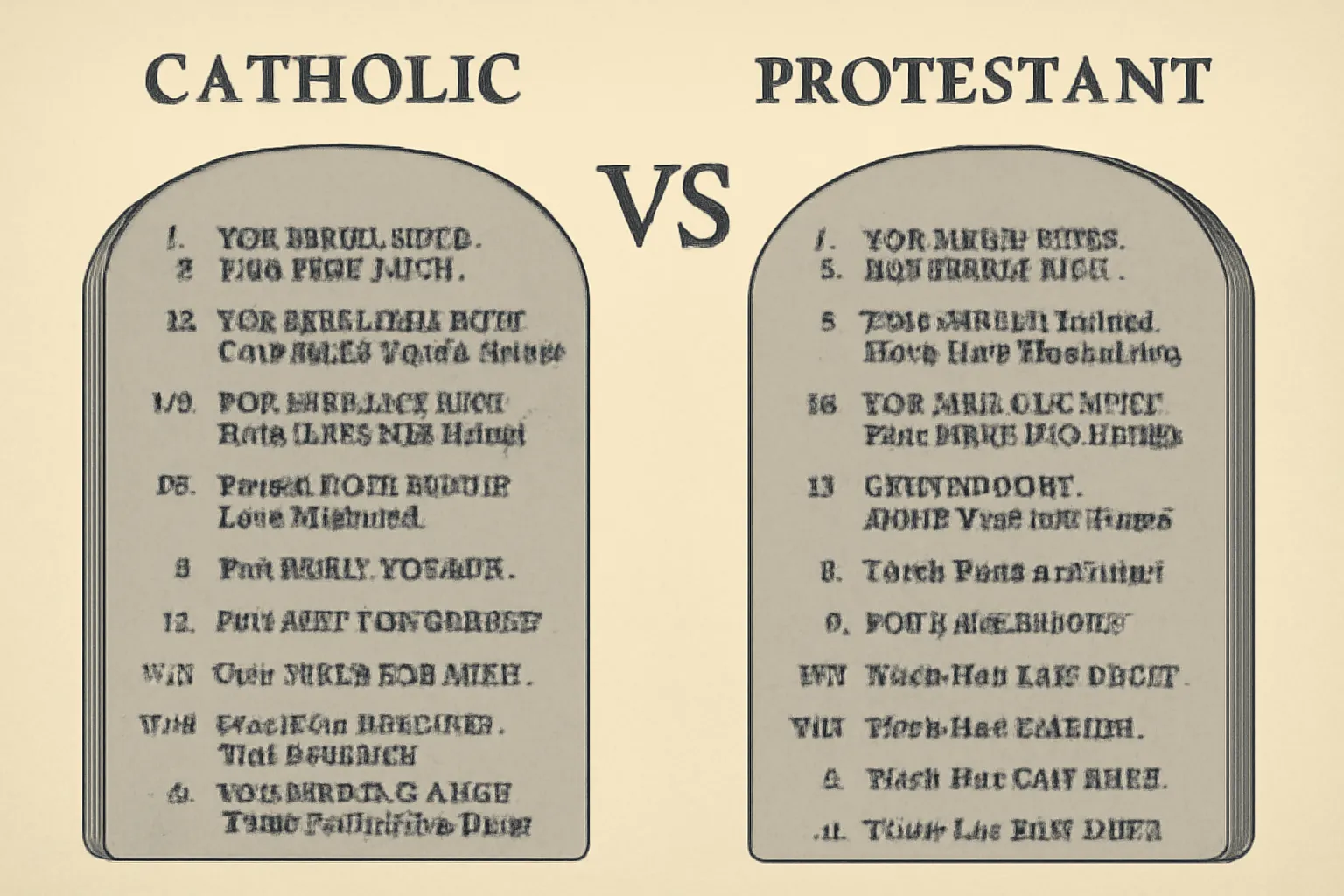
In the Catholic tradition, the Ten Commandments are typically presented as follows. Note the consolidation of the first prohibition (no other gods and no idols) into one command, and the Sabbath instruction as a separate command later in the list:
I am the Lord your God: you shall have no strange gods before me.
You shall not take the name of the Lord your God in vain.
Remember to keep holy the Sabbath day.
Honor your father and your mother.
You shall not kill (murder).
You shall not commit adultery.
You shall not steal.
You shall not bear false witness against your neighbor.
The Protestant Ten Commandments are often presented with a two-commandment version of the opening clause or with a two-part first commandment. A widely taught version used by many Lutherans, Anglicans, and Reformed churches is shown below as two separate items at the start, followed by the other commandments. This reflects the common Protestant approach that separates the prohibition against other gods from the prohibition against idols:
You shall have no other gods before me.
You shall not make for yourself a graven image (idol).
You shall not take the name of the Lord your God in vain.
Remember the Sabbath day, to keep it holy.
Honor your father and your mother.
You shall not murder.
You shall not commit adultery.
You shall not steal.
You shall not bear false witness against your neighbor.
You shall not covet your neighbor’s house, you shall not covet your neighbor’s wife, or anything that belongs to your neighbor.
Important note: Some Protestant traditions do not use the exact same eight or ten words as others. In particular, certain denominations treat the second commandment as a prohibition against all idols as a standalone commandment, while others keep the prohibition as a function of the first commandment. In still other variants, the wording of the tenth commandment expands to explicitly cover a neighbor’s possessions beyond just their house or wife. The key point is that these variations are different ways of expressing the same moral duties, not a completely different moral code.
What counts as “the same” and what counts as a difference?
When people compare the Catholic Ten Commandments with the Protestant Ten Commandments, there are several recurring themes:
First commandment structure: Catholics tend to summarize the first commandment as one unit, including the prohibition against other gods and the prohibition against making idols. In many Protestant lists, these are two separate bullets; this is the most visible difference in the opening section of the Decalogue.
Sabbath language: The Catholic list uses language like “Remember to keep holy the Sabbath day,” while many Protestant traditions say “Remember the Sabbath day, to keep it holy.” The practical outcome—setting aside time for worship and rest—remains central across branches, but the exact phrasing and the day associated with Sabbath are interpreted with distinct historical emphasis (the Lord’s Day in Christian practice).
Idolatry and images: Catholics treat the prohibition on idols as part of the first commandment, whereas Protestants typically place “no graven images” as a separate commandment early in the list. The effect is a different grasp of how idolatry relates to true worship, even though both traditions condemn idolatry in practice.
Coveting: Both streams eventually pronounce the prohibitions on coveting, including the neighbor’s wife and neighbor’s goods. The wording may differ, but the moral boundaries—respect for family integrity and property—are consistent across both traditions.
Why these differences matter in worship, practice, and teaching
The divergence in numbering and phrasing is not merely academic. It shapes catechesis, liturgy, and the way believers approach moral questions. Here are several areas where the differences matter:
Catechesis and memory: A list that can be memorized as ten distinct commands is helpful for teaching children and new converts. The Catholic approach emphasizes a compact opening unit, which some learners find straightforward, while the Protestant approach emphasizes a two-part beginning that stresses the seriousness of idolatry and covenantal fidelity.
Worship and Sunday observance: Because Sabbath language is tied to worship and rest, the way the commandment is stated can influence how believers view Sunday worship. Catholics typically interpret Sunday as the Lord’s Day and keep it holy through communal worship and rest, paralleling Protestant Sunday worship practices. The historical reason for the shift from Sabbath (Saturday) to Sunday is rooted in the early church’s celebration of the Resurrection, a shift that is interpreted and applied in different ways by different traditions.
Art and devotion: The linkage of the first commandment to idolatry can shape attitudes toward religious images, icons, and devotional practices. In Catholic tradition, images and icons are used in liturgy and personal devotion in a way that is theologically distinct from idolatry, while many Protestant traditions typically emphasize a more cautious stance toward images in worship.
Ethical focus: The final commandments on coveting safeguard not only property but also the sanctity of family life and relationships. Across traditions, these prohibitions protect social order and personal integrity, though the exact phrasing may evolve to match historical and cultural contexts.
Comparative notes: common ground and nuanced differences
Despite the differences in numbering and emphasis, there is broad theological consensus about the moral obligations contained in the Decalogue:
Monotheism: Both Catholic and Protestant traditions uphold the belief in one God and insist that worship is due to the Creator alone.
Respect for God’s name: Respecting the divine name and honoring God through reverent speech is a common ethical thread.
Holiness of worship: Both streams regard Sunday worship (or Lord’s Day observance) as central to the life of the church, though the vocabulary for the day may differ.
Respect for life and family: Prohibitions against murder, adultery, and bearing false witness reflect a shared concern for the sanctity of life, marriage, and truth in community life.
Respect for property and neighbor: Prohibitions against theft, coveting, and deceit uphold the rights and dignity of neighbors and the social fabric of communities.
Practical implications for believers today
For someone studying the topic catholic 10 commandments vs protestant 10 commandments, a few practical implications stand out:
Catechesis and memory aids: Churches choose mnemonic devices, catechisms, or catechetical videos that align with their tradition. If you are studying with a Catholic catechism, you may encounter a single first commandment; in a Protestant catechism, you may see two early commands on God’s exclusivity and images. Being aware of this helps avoid confusion when comparing texts or teaching children who move between communities.
Iconography and worship: Catholics often use and venerate sacred imagery as part of a broader understanding of the faith, whereas some Protestant communities exercise more stringent views about religious images. This difference flows from the way the commandments are framed in each tradition’s catechetical materials.
Interpretation of sabbath and Lord’s Day: The call to keep the day holy has practical implications for worship schedules, rest, and the rhythm of life. Different traditions interpret how to honor the day, pace, and activities; however, the underlying commitment to worship and rest remains intact across both traditions.
Ethical living in family and society: Both groups teach fidelity within marriage, honesty in speech, and truthfulness in dealing with others. The commandments function as a moral compass for daily life, not only for church services but also for family life, business ethics, and civic responsibility.
Common questions about the Decalogue across traditions
Many readers come to this topic with recurring questions. Here are a few that often arise, along with concise answers:
Are Catholics and Protestants really breaking the same commandments into different numbers? Yes, essentially. The content overlaps, but the presentation—especially the treatment of idols and the opening commandments—differs in a way that changes the numbering.
Which is older, the Catholic or Protestant list? Both trace back to the same biblical text, Exodus 20 and Deuteronomy 5. The divergence is a matter of medieval and Reformation-era catechesis and ecclesial tradition more than a biblical revision.
Does this mean one tradition is “right” and the other “wrong”? Not at all. Each tradition seeks to faithfully interpret Scripture through its own theological framework and historical experience. Both aim to guide believers toward worship of the one God and living moral, holy lives.
If you are doing research or simply trying to understand a specific catechetical resource, be mindful of:
Edition and tradition: Some Catholic catechisms are concise while others elaborate with additional clarifications; likewise, Protestant resources can range from Lutheran, Anglican, Reformed, to Baptist approaches. The numbering and even the exact text can shift between editions.
Language of translation: Translations of Exodus 20 can influence how a given commandment is phrased. A translators’ choice may emphasize “graven image” vs. “idol” or “remember the Sabbath” vs. “keep it holy.”
Contextual practice: Local church practice—such as liturgy, preaching, or Sunday school curricula—often shapes how the Decalogue is taught to a congregation, reinforcing particular emphases even when the core prohibitions are the same.
For readers seeking a concise synthesis of the key differences between the Catholic 10 Commandments and the Protestant 10 Commandments, here are the top three points:
Numbering and structure: The Catholic approach consolidates the idols prohibition into the first commandment, while many Protestant traditions separate it as a distinct second commandment. This is the most visible difference in the opening portion of the Decalogue.
Idolatry and images: In Catholic teaching, the prohibition against making or worshiping idols is effectively part of the first commandment; in many Protestant settings, it is a standalone commandment early in the list.
Worship language and the Sabbath: The Sabbath language in the Catholic version is linked to Sunday worship as the Lord’s Day in Catholic practice, while Protestant versions frequently frame it as remembering the Sabbath day and keeping it holy, with Sunday as the primary day of worship in most communities.
The comparison of the Catholic Ten Commandments and the Protestant Ten Commandments is more than a trivia exercise. It reveals how different Christian communities interpret, teach, and live out the same biblical material. The core moral commitments—namely, love and fidelity to God, reverence for God’s name, the sanctity of worship, and respect for life, family, and neighbor—are shared across traditions. The variations in numbering, emphasis, and phrasing reflect distinct historical pathways, hermeneutical approaches, and pastoral priorities. By engaging with these differences thoughtfully, Christians can gain a deeper appreciation for their own tradition and develop a respectful understanding of others. The Decalogue remains a foundational text for ethical instruction, liturgical life, and spiritual formation in both the Catholic Church and diverse Protestant communities.
If you’d like to explore this topic further, consider sections of your own catechism or church’s teaching materials. Compare the wording used in the catechism to a Protestant catechism from a different tradition. Look at the Bible translations used in each tradition’s study materials. You may find that the differences illuminate the remarkable unity of the Christian moral vision, even as they celebrate the richness of diverse ecclesial expressions.
In sum, recognizing the differences in numbering and the shared ethical core can help believers, scholars, and curious readers navigate discussions about how Catholics and Protestants understand God’s law. The discussion is not about a competition between traditions but about a conversation that reveals how the ancient Decalogue continues to speak into modern life with relevance, discipline, and exhortation.