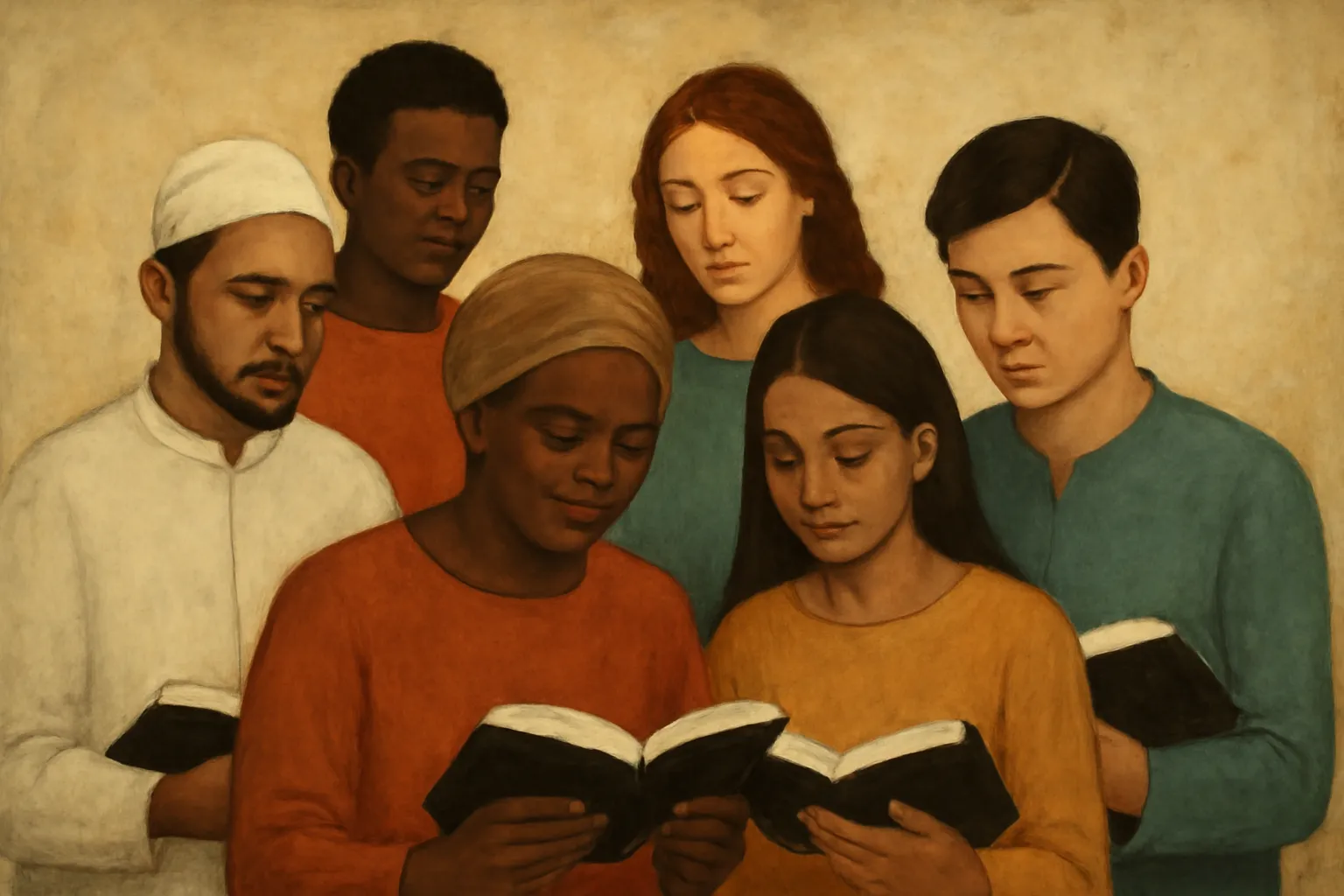
Diversity Scripture is a term that scholars, theologians, and practitioners increasingly use to describe the way sacred writings engage with the wide spectrum of human difference. It signals a shift from seeing sacred texts as static repositories of one-size-fits-all doctrine to viewing them as living sources that invite ongoing interpretation, ethical reflection, and communal practice around topics like race, gender, ethnicity, ability, sexuality, class, language, culture, and national belonging. This article surveys what diversity scripture might mean when we read, study, teach, and live with sacred texts in pluralistic communities. We will examine definitions, core concepts, examples across faith traditions, interpretive frameworks, and practical approaches for incorporating diversity and inclusion into religious life.
The phrase diversity scripture embraces several intertwined ideas. First, it recognizes that sacred texts often contain voices that celebrate or at least acknowledge a broad human horizon—people who differ in race, language, culture, gender, ability, or circumstance. Second, it foregrounds the interpretive work of communities that read these texts through the lenses of justice, mercy, and hospitality. Third, it emphasizes that inclusion is not a marginal add-on but a central concern of religious ethics and communal life. In this sense, diversity scripture refers not to a single book or a fixed doctrine, but to a family of readings that interpret holy writ in ways that honor dignity, reduce oppression, and promote flourishing for all beings.
Foundations of Diversity Scripture
To grasp diversity scripture, it helps to establish some foundations about how sacred texts have historically addressed difference. Across traditions, we can identify several common strands that recur in diverse ways:
Hospitality and welcome as a virtue rooted in divine prompting. Many sacred narratives invite openness to strangers, guests, and outsiders, because welcome is associated with divine mercy or justice.
Prophetic critique of power that challenges exclusionary structures and calls for justice for the marginalized.
Universalism and particularism in conversation. Some scriptures articulate universal moral claims while also honoring particular communities, languages, or locations; the juxtaposition can yield a robust ethic of inclusion that respects difference.
Moral imagination that expands the circle of concern beyond one’s immediate group to the broader human family and creation itself.
Historical-contextual interpretation that sees texts as products of specific times and places, inviting readers to translate ancient values into contemporary practices without erasing their integrity.
Key Terms and Concepts in Diversity Scripture
Understanding diversity scripture relies on recognizing several foundational terms. The following glossary highlights words that appear frequently in discussions of inclusion, justice, and sacred text interpretation. Throughout this article, these terms will be given emphasis to help readers notice how they operate within different traditions.
Inclusion: the practice or policy of including all people, especially those who might be marginalized, in the life of a community or in the interpretation of a text.
Diversity: the presence of a wide range of human differences within a community, and the recognition that such differences enrich shared life and insight.
Equality: the principle that all persons possess inherent worth and should be treated with fairness and respect before divine or human law.
Hospitality: a virtue in many sacred texts that enjoins generosity to strangers, guests, and those at the social margins.
Justice: a robust ethical aim that seeks to repair harm, dismantle oppressive systems, and create conditions in which every person can thrive.
Mercy (or compassion): a relational virtue that guides care for the vulnerable and emphasizes empathy across differences.
Interpreation (hermeneutics): the scholarly and spiritual process of reading sacred texts to discern meaning that speaks to current ethical and social realities.
Pluralism: the recognition that multiple religious traditions and interpretations can offer legitimate insight into the sacred and the good.
Universalism: the belief that certain moral or spiritual truths extend to all people, regardless of background or circumstance.
Particularity: the acknowledgment of unique identities, cultural contexts, and historical particularities within a universal call to justice.
Diversity in Major Sacred Texts: A Cross-Tradition Perspective
Although the term diversity scripture is contemporary, many sacred texts carry passages, themes, and ethical commitments that have been interpreted to support inclusion and dignity for diverse peoples. Below, we survey a spectrum of traditions to illuminate how inclusive readings emerge in various canonical literatures. This survey is not exhaustive, but it aims to illustrate substantial patterns of inclusive language, ethical obligation, and communal practice that readers can carry into modern life.
Christianity: Hospitality, neighbor-love, and the widening circle
In Christian scriptures, themes of neighbor love and hospitality repeatedly expand the circle beyond bloodlines and tribe. The parables and teachings attributed to Jesus challenge exclusivist instincts and elevate the status of those on the social margins. For instance, certain passages emphasize that the good life is demonstrated through acts of mercy toward strangers and the vulnerable, while other texts advocate a universal invitation to the kingdom of God that transcends ethnic or social boundaries. In practice, communities often interpret these themes as a call for inclusion, as well as for structural justice—addressing poverty, discrimination, and unequal access to resources. Contemporary readers may highlight how diversity scripture informs inclusive worship, non-discriminatory ministry, and interfaith dialogue as expressions of faithfulness to core ethical commitments.
Important examples of inclusive interpretation frequently center on broad theological claims of love, justice, and unity in Christ or in God’s merciful design. Even as Christians wrestle with divergent doctrinal positions, many faith communities emphasize that justice and mercy are not optional add-ons but essential features of authentic discipleship.
Judaism: Humanity, hospitality, and the prophetic call to repair the world
In Jewish scripture and rabbinic interpretation, the imperative to care for the stranger (ger) and to welcome diverse voices is woven into both law and story. Texts that address hospitality, fair business practices, and the dignity of all people reflect a longstanding commitment to social ethics. The prophetic tradition often reframes national or ethnic superiority as a failure of justice, urging the people to reflect the divine image in every neighbor, regardless of origin. This tradition’s approach to diversity scripture emphasizes that:
Law codes require generous treatment of the vulnerable, including strangers, widows, and orphans.
Poetic and prophetic literature celebrates human unity while urging humility and solidarity across differences.
Midrashic and Talmudic discussions expand the ethical imagination, showing how particular circumstances can demand nuanced, inclusive responses in daily life and communal practice.
For contemporary readers, these streams offer a disciplined method for translating ancient principles of justice into modern advocacy for immigrant rights, anti-discrimination measures, and equitable governance—demonstrating how diversity scripture remains a living, interpretive project rather than a static archive.
Islam: Mercy, justice, and the equality of all believers
Islamic scripture centers on prophetic guidance and ethical commandments that repeatedly stress mercy and justice. The Qur’an, for example, contains verses that call believers to acknowledge God’s signs in humanity’s diversity and to treat others with fairness, regardless of background. The tradition’s later intellectual and devotional currents—such as Sufi ethics, juristic reflections, and prophetic biographies—have long wrestled with questions of inclusion, social responsibility, and the status of marginalized groups. In many interpretive communities, the result is a diversity scripture that champions hospitality toward guests, protection for the vulnerable, and the obligation to pursue communal harmony while maintaining fidelity to divine law. Contemporary reading often engages with inclusion in worship and equitable access to resources as practical expressions of faithfulness to the universal dimensions of truth in Islam.
Hinduism and Buddhism: Universal compassion amid plural paths
In Hindu and Buddhist traditions, the question of how to honor diverse beings often centers on the universal ethic of compassion (karuṇā) and the interdependent nature of all life. Sacred literature across these streams frequently presents a rich palimpsest of stories, metaphors, and teachings that can be read as endorsing an expansive view of community and responsibility. For Hinduism, the concept of seva (selfless service) and the recognition of many paths to spiritual realization can be read as invitations to embrace diverse communities without coercion. In Buddhism, the emphasis on compassion for all sentient beings and the goal of alleviating suffering regardless of identity supports a robust ethos of inclusion. Read through a diversity scripture lens, these traditions highlight that spiritual practice can be intimate and universal at once, inviting people of different backgrounds to participate in ethical living and meditative discipline without erasing distinction.
Real-world applications often include inclusive liturgical formations, multilingual teachings, and the encouragement of interfaith dialogue that honors difference while pursuing common ethical horizons.
Sikhism, Jainism, and Indigenous Spiritualities: Equality, dignity, and mutual belonging
Several traditions rooted in a sense of universal equality place a premium on social justice and the dignity of every person. Sikhism’s emphasis on the equality of all humans before the divine, the practice of langar (communal meal) as a radical egalitarian act, and the rejection of caste-based discrimination provide a clear scriptural and communal framework for inclusion. Jainism’s insistence on nonviolence and reverence for all life, coupled with rigorous ethical codes, maps a path toward dignity and respect for diversity in everyday conduct. Indigenous spiritualities frequently center reciprocity with the land, kinship networks, and the honoring of ancestors and diverse tribes or clans as part of a lived cosmology of care. Taken together, these traditions contribute a productive vocabulary for diversity scripture that emphasizes equality, mutual belonging, and the interdynamics of communities across difference.
In modern pluralistic contexts, this can translate into inclusive leadership models, culturally responsive education, and ritual practices that invite participation from a broad range of cultural backgrounds while remaining faithful to core beliefs.
Indigenous and Global Spiritualities: Place, memory, and treaty with diversity
Indigenous spiritualities offer powerful perspectives on diversity that center relationships, place-based wisdom, and a responsibility to future generations. When readers engage indigenous scriptures and oral traditions as diversity scripture, they often encounter ethical commitments to hospitality, stewardship, and communal discernment that cross boundaries of language and nation. These voices remind readers that sacred texts do not exist in a vacuum; they co-evolve with living communities and landscapes. Interwoven themes include the sacredness of hospitality to humans and nonhumans alike, the need to resist extractive or oppressive practices, and the mutual care that sustains vibrant, diverse ecosystems. Such readings reinforce the idea that inclusion is not merely a social policy but a spiritual practice rooted in accountability to creation and to one another.
The Role of Interpretation: How Readers Shape Diversity Scripture
Interpretation is the engine that moves diversity scripture from text to living practice. Across traditions, scholars and communities employ a range of hermeneutical approaches to draw out inclusive meanings. Several influential methods include:
Contextual hermeneutics: Reading sacred texts with attention to historical circumstances, social power dynamics, and the lived realities of modern communities.
Liberation theology and praxis: Reading texts as tools for justice, particularly for marginalized groups, and translating insight into concrete advocacy and reform.
Feminist and intersectional readings: Highlighting how gender, race, class, and other axes of identity shape textual interpretation and religious practice.
Interfaith and intercultural dialogue: Engaging with other traditions to discern common ethical truths while respecting difference.
Liturgical and ritual adaptation: Modifying worship practices to welcome diverse participants without coercing belief or identity.
These interpretive modes demonstrate that diversity scripture is not a single agreed-upon reading but a dynamic conversation across communities. They also remind us that textual authority does not trump the lived claims of justice, compassion, and inclusion. In many religious communities, the interpretive work is ongoing, participatory, and situated in local contexts—showing that inclusion is a practice cultivated through education, leadership, and everyday encounters.
Critiques and Debates Surrounding Diversity Scripture
Like any evolving field, the project of diversity scripture faces critiques and tensions. Grappling with these debates helps communities avoid simple conclusions and encourages more careful, nuanced practice. Common concerns include:
Textual authority versus lived experience: How do communities balance traditional injunctions with contemporary commitments to inclusion?
Risk of normative liberalism: Critics worry that readings focused on inclusion could become disconnected from the historical and doctrinal core of a faith tradition.
Competing claims among identities: Some argue that emphasizing one dimension of diversity might inadvertently marginalize another (for example, how to honor both cultural specificity and universal ethical claims).
Mission and assimilation concerns: Questions arise about whether expanding inclusion changes the doctrinal boundaries of a community, and if so, how to maintain fidelity while remaining welcoming.
Power and governance: The inquiry into who gets to interpret texts and whose voices count most in community discussions is itself a crucial part of diversity scripture.
These debates are not signs of failure but signs of vitality. They indicate that communities are actively wrestling with how sacred texts address a rapidly changing world. A robust approach to diversity scripture often involves transparent conversation, accountability structures, and a commitment to translating sacred principles into tangible benefits for the vulnerable and marginalized.
Practical Approaches to Implementing Diversity Scriptural Readings
In congregational life, educational settings, and personal study, readers can translate the ideals of diversity scripture into concrete actions. The following approaches are designed to be practical, adaptable, and respectful of different faith traditions:
Inclusive study groups: Create study spaces that welcome participants from varied backgrounds, with materials that reflect multiple traditions and perspectives.
Intercultural liturgy: Develop worship formats that honor diverse languages, musical styles, and symbolic languages while maintaining doctrinal integrity.
Community service and advocacy: Engage in service projects and policy advocacy that address systemic inequalities—poverty, discrimination, and barriers to education and health care.
Multilingual education: Provide resources in multiple languages to ensure accessibility for immigrant communities, refugees, and indigenous members.
Narrative inclusion: Center personal stories of diverse community members in teaching and preaching, ensuring voices from marginalized groups guide interpretation and practice.
Ethical review processes: Establish committees or circles that assess proposed changes to liturgy, governance, or policy for alignment with inclusion and justice values.
Ritual accessibility: Adapt rituals to accommodate diverse physical abilities, family structures, and cultural preferences, while preserving meaningful symbolism.
Clear boundaries and hospitality: Distinguish between welcoming participants and endorsing every external belief; provide space for dialogue while maintaining shared commitments where necessary.
Reading diversity scripture with care also means recognizing that inclusion should not compromise safety or integrity. Communities often distinguish between inclusive language that honors human dignity and doctrinal positions that require shared beliefs or practices. The goal is to cultivate a form of inclusion that deepens spiritual life, strengthens community, and respects the dignity of all persons.
Case studies can illuminate how abstract principles translate into real-life practice. The following scenarios illustrate how different communities might apply diversity scripture in everyday life:
Case Study A: A multicultural worshipping community updates its liturgy
A predominantly monolingual congregation partners with immigrant families to create a worship service that includes prayers in multiple languages, invites musicians from varied cultural backgrounds, and centers readings that emphasize universal human dignity. The leadership team uses a participatory interpretation approach, inviting attendees to share personal reflections on sacred texts. The outcome is a more inclusive service where people feel a sense of belonging, while the core creed remains identifiably intact for those who affirm it.
Case Study B: A teacher uses diverse sacred texts to teach ethics
A religious school adopts a curriculum that foregrounds inclusion and justice by comparing ethical themes across several traditions. Students read passages about hospitality, care for the vulnerable, and the ethical treatment of strangers, then discuss how these principles could apply to local issues—such as housing inequalities, school funding disparities, and community health resources. The goal is not to harmonize every doctrine but to nurture shared moral reasoning grounded in sacred literature.
Case Study C: A faith community confronts discrimination within its own ranks
When a tradition encounters internal debates about leadership and inclusion, a governance reform is proposed in light of diversity scripture. The process includes listening sessions with marginalized members, a public statement reaffirming commitments to equality, and the creation of a commission to monitor bias in hiring, preaching, and programming. The community aims to embody its stated values in both policies and practices.
In a world characterized by rapid migration, global interconnectedness, and persistent social inequities, diversity scripture offers a framework for civil, faithful living. The ethical impulse to see the divine image in every person and to value each voice invites communities to cultivate both humility and courage. When sacred texts are studied with an eye toward justice, compassion, and hospitality, they become engines for social transformation and personal growth. The goal is not to dilute tradition but to interpret it in ways that sustain communities under conditions of pluralism, plural identities, and cross-cultural contact. In this sense, diversity scripture is a constructive answer to the modern demand for spiritual integrity alongside social responsibility.
Whether you are a student, teacher, pastor, rabbi, imam, author, or lay leader, the following guidelines can help you engage in responsible and fruitful study of diversity scripture:
Center human dignity in all discussions, ensuring that debates remain anchored in the intrinsic worth of every person.
Honor multiple intelligences: recognize that people engage sacred texts through reason, emotion, memory, ritual, and creative expression.
Practice humility: acknowledge the limits of your own tradition and be open to learning from others’ perspectives.
Distinguish between belief and practice: separate doctrinal commitments from ethical actions that promote inclusion and justice.
Encourage co-creative interpretation: invite diverse voices to participate in study, leadership, and decision-making processes.
Provide resources for ongoing learning: offer readings, lectures, and workshops that deepen understanding of diverse scriptures and their applications.
Build accountability mechanisms: create spaces for feedback, error remediation, and restorative justice when harm occurs.
The project of diversity scripture invites readers to approach sacred texts not as fixed monuments but as living documents that speak differently in different times and places. By embracing a broad and responsible approach to interpretation—one that centers justice, hospitality, and equal dignity—we can foster communities where inclusion and faith deepen each other. This approach respects the integrity of particular traditions while recognizing the universal ethical claims that many sacred writings across traditions share. In practice, diversity scripture means committing to ongoing dialogue, shared action, and careful discernment about how best to translate ancient wisdom into compassionate, equitable, and sustainable ways of living together. If we read with care and act with courage, diverse communities can witness to the unity that many of these sacred texts already anticipate: a world in which every person is valued, every voice is heard, and every life is treated with undeniable worth.