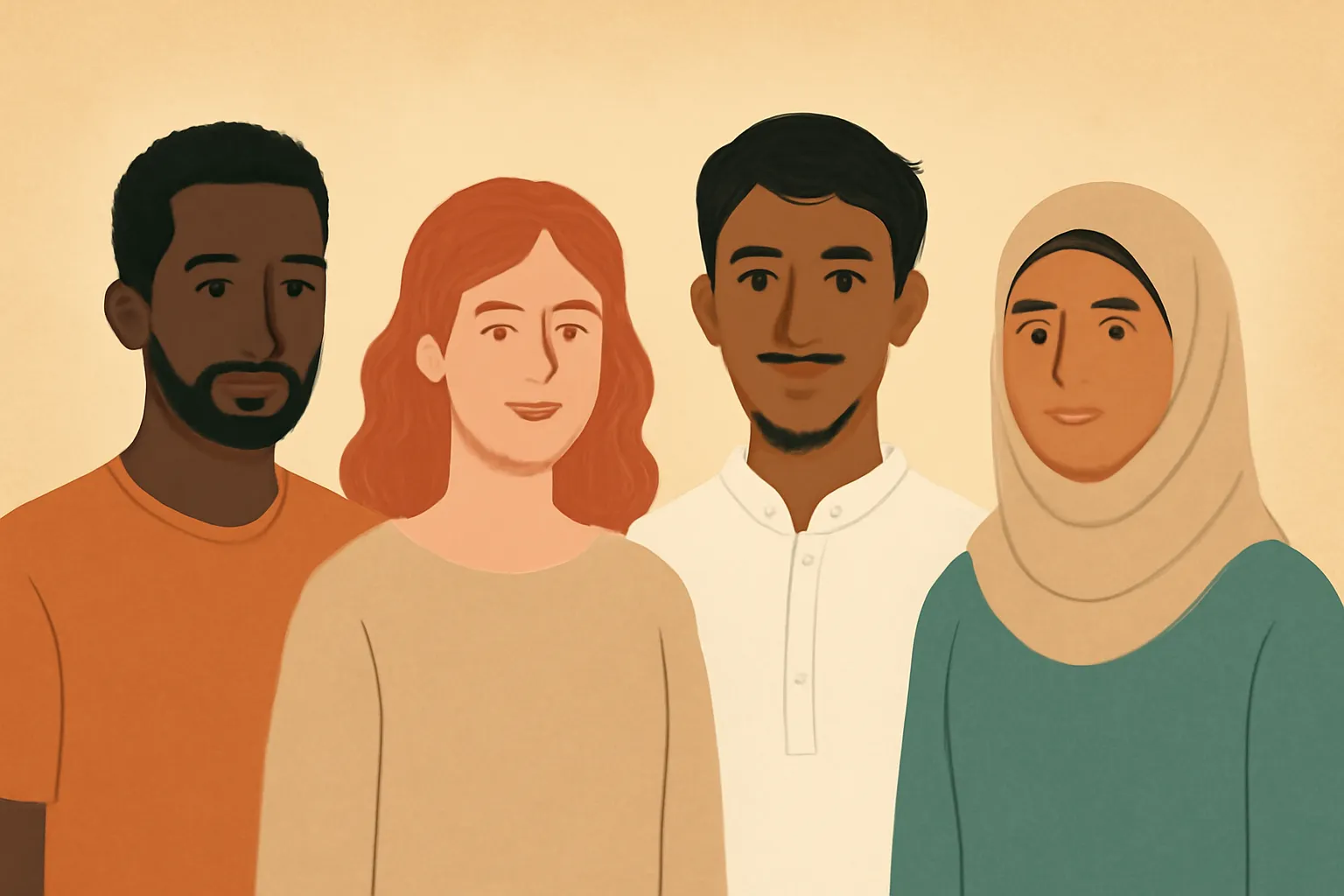
The Bible speaks to the issue of diversity not as a modern social slogan but as a foundational reality of creation, redemption, and life in community. From the very beginning, Scripture presents humanity as a rich tapestry made in the image of God, with a history that unfolds across cultures, languages, and peoples. In the pages of Scripture, inclusion is not about erasing difference but about honoring the dignity of every person while pursuing unity in Christ. This article surveys key verses and themes that illuminate how faith communities can welcome, value, and embody biblical diversity today.
Foundations in Scripture: Diversity in Creation and Covenant
Created in the Image of God
The opening chapters of the Bible establish that every person bears God’s image. Genesis 1:27 states plainly that God created humanity as male and female in His own image. This foundational truth grounds every discussion about dignity, worth, and community. When a community forgets this image-bearing reality, it loses its compass for fair treatment and mutual respect. This is why the inherent value of each person—regardless of race, gender, class, or background—becomes a consistent thread throughout Scripture.
The Nations and God’s Global Purpose
Diversity grows from God’s own plan for the world. Genesis 12:3 declares that through Abraham all the nations of the earth will be blessed. The biblical narrative follows this promise forward, highlighting the inclusion of non-Israelites in God’s redemptive plan. The Psalms echo this theme as well, inviting all peoples to acknowledge the Lord (for example, Psalm 22:27–28 and related passages that anticipate widespread recognition of God’s sovereign rule).
In the prophetic literature, the hope broadens: foreigners and strangers become part of worship, and the temple becomes a house of prayer for all nations. Isaiah 56:6–7 and similar verses point to a future where people from every background are welcome into God’s presence. The apostolic witness in the New Testament expands the circle even further: in Acts 10:34–35, Peter declares that God shows no partiality, inviting Gentiles into the same grace offered to Jews.
Diversity in the Body of Christ: Unity Without Uniformity
Many Parts, One Body
The New Testament uses the body as a powerful metaphor for how diverse gifts and people fit together in unity. 1 Corinthians 12:12–27 emphasizes that just as a body has many parts with different functions, the body of Christ is made of diverse believers who all contribute to the whole. No part can be dismissed as insignificant, and no part should exalt itself over another. The overarching principle is interdependence and mutual care.
When God gives spiritual gifts and callings, the aim is not division but harmony, growth, and maturity. In Romans 12:4–5, believers are urged to recognize that though we have many parts, we form one body in Christ. Ephesians 4:11–16 describes leadership and equipping as a means to “grow up in every way into him who is the head, into Christ.” The result is a church that maintains unity through love, truth, and service, while preserving diversity of background and talent.
Jew and Gentile, Slave and Free: The Ground of Equality
The principle of equality in Christ is a recurring refrain. Galatians 3:28 proclaims that there is neither Jew nor Gentile, slave nor free, male nor female, for all are one in Christ Jesus. This radical equality does not erase differences but places all believers on equal footing before God. Colossians 3:11 adds that in Christ there is no distinction of ethnic or social status; instead, all are made one, and the Christ-community should reflect that unity in daily life.
Inclusion, Partiality, and the Reforming of Social Boundaries
Confronting Partiality in Worship and Community Life
Biblical ethics repeatedly challenge favoritism and exclusion. James 2:1–4 warns against showing partiality to the rich while marginalizing the poor. The underlying claim is simple: love and faith in Christ must reshape the way we treat everyone, especially those who might be seen as outsiders. The story of Cornelius in Acts 10 functions as a narrative correction, teaching the early church that God’s grace is for all peoples, not just one favored group.
Breaking Down the Dividing Walls
The apostle Paul highlights a central achievement of the Jesus movement: breaking down the “dividing wall of hostility” between peoples. Ephesians 2:14–16 proclaims that Christ Himself is our peace, who has reconciled Jews and Gentiles, uniting them into one new humanity. This reconciliation is not merely doctrinal; it is practical—reshaping prejudices, social norms, and communal life so that inclusion becomes a lived reality.
Practical Implications for Churches and Communities
Worship Across Cultures and Languages
Diversity in worship is a covenantal value, not simply a preference. Many churches cultivate multilingual services or culturally blended worship expressions to reflect the body’s breadth. The biblical horizon includes voices from every tribe and tongue—astonishing in Revelation 7:9 as a worshiping multitude from “every nation, tribe, people and language.” When ministry spaces reflect this breadth, the church embodies a visible sign of the coming Kingdom.
Leadership, Service, and Equal Access
Biblical diversity calls for equitable leadership opportunities and inclusive governance. Diversity in leadership is not about token representation but about authentic gifting being recognized and trusted for mature ministry. Verses like 1 Corinthians 12:28–31 and Romans 12:6–8 emphasize diverse gifts serving the common good, while 1 Timothy 2:4 affirms that God desires all people to be saved and come to the knowledge of the truth, a truth that belongs to everyone.
The biblical ethic of inclusion extends to the vulnerable and unfamiliar. The Law commanded care for the resident alien (foreigners) in many places, and the prophets repeatedly called Israel to welcome the stranger. In a New Covenant frame, Jesus’ ministry and the apostles’ teaching continue that pattern by lifting up the dignity of immigrants, the poor, women, children, and those on the margins. James 1:27 and related passages challenge the church to practice religion that is pure and undefiled—care that sustains vulnerable people and welcomes outsiders.
Healthy Diversity: Guardrails Against Relativism
Diversity must be anchored in the unchanging truth of the Gospel. The unity of the Spirit and the bond of peace (Ephesians 4:3) must be nourished by shared faith, not by cultural compromise or worldly syncretism. Churches can cultivate honest dialogue, biblical literacy, and a shared confession that honors diversity while remaining faithful to core doctrines. This balance protects both inclusion and biblical truth.
Common Questions and Clarifications
Is Diversity the same as Uniformity?
No. Biblical diversity envisions a community where many gifts, backgrounds, and expressions are welcomed, yet unity is not sacrificed. The key distinction is that diversity honors differences while unifying in Christ, safeguarding essential beliefs while celebrating variety in practice and culture.
Does Inclusion Require Compromise on Scripture?
Inclusion is not a call to abandon doctrinal fidelity. Rather, it is a call to interpret and apply Scripture so that the love of Christ is evident in how we treat one another. The biblical stance is that the Gospel reconciles, heals, and creates a new community—one that does not dilute truth but manifests it through love and justice.
How Do We Apply This in a Local Context?
Practical steps include intentional hospitality, language of invitation, and policies that remove barriers to participation and leadership. It also means listening to voices from diverse backgrounds, examining biases, and training leaders to steward diversity in a way that builds up the church and serves the wider community.
Verses for Reflection and Study: A Curated List
The following curated verses present a spectrum of biblical teaching on diversity, inclusion, and unity. Consider meditating on them individually, or tracing thematic threads across multiple passages.
Genesis 1:27 — Created in God’s image; intrinsic dignity for all people.
Genesis 12:3 — Blessing to all nations through Abraham’s descendants.
Genesis 11:7–9 — The spread of languages and peoples as part of God’s plan, leading to diverse cultures.
Psalm 67:2–4 — People everywhere praising God; a universal invitation.
Isaiah 56:6–7 — Foreigners united in worship; inclusion in God’s house.
Acts 10:34–35 — God shows no partiality; Gentiles welcomed into the church.
Romans 12:4–5 — One body with many parts; functional diversity in unity.
1 Corinthians 12:12–27 — The body has many parts; all are needed and valued.
Galatians 3:28 — In Christ, distinctions do not determine worth; all are one.
Ephesians 2:14–18 — Reconciliation and unity through Christ; breaking down barriers.
Ephesians 4:4–6 — One Spirit, one Lord, one faith, one baptism—yet diverse in gifts.
Colossians 3:11 — In Christ, there is no Greek and Jew, circumcised and uncircumcised; all are one.
1 Timothy 2:4 — God desires all people to be saved; universality of salvation.
James 2:1–4 — Do not show favoritism; genuine faith acts justly toward the marginalized.
James 2:8–9 — The royal law: love your neighbor as yourself—refusing to privilege one group over another.
John 13:34–35 — A new commandment: love one another as proof of discipleship; unity in the world marked by love.
John 17:21–23 — Jesus prays for unity among his followers; that the world may believe the Father sent Him.
Revelation 7:9 — A worshiping multitude from every nation, tribe, people, and language; ultimate diversity in glory.
Revelation 5:9 — The Lamb’s worthiness celebrated by people from every background; unity in praise.
Psalm 117:1–2 — A short, universal invitation to praise God for His faithfulness to all peoples.
These verses collectively encourage readers to pursue inclusion as an expression of faithfulness, while staying anchored in the essentials of the Gospel. They show that diversity is not a problem to solve but a divine gift to steward—an invitation to live out the Kingdom in the everyday realities of family, church, work, and neighborhood.
Embracing Biblical Diversity as a Mission and a Community Practice
The biblical witness presents diversity as a fundamental dimension of God’s plan for humanity and the church. From the opening chapters through the prophetic hope and the apostolic teaching, Scripture invites believers to honor the dignity of every person, to recognize the value of varied gifts, and to pursue unity in Christ that does not demand sameness but demands faithfulness. In practical terms, this means churches that welcome the immigrant and the poor, leaders who reflect a range of backgrounds, and worship that speaks in multiple languages and styles while maintaining a shared confession of Jesus Christ as Lord.
If your community wants to cultivate a healthier, more biblical culture of diversity, start with study and dialogue grounded in Scripture, coupled with concrete actions—hospitality, equitable leadership, and faithful preaching that proclaims the Gospel in ways meaningful to people from different walks of life. By placing inclusion, unity, and love at the center of ministry, a church can become a powerful witness to the world: a space where every person is seen, valued, and invited to contribute to God’s redemptive work in the world.