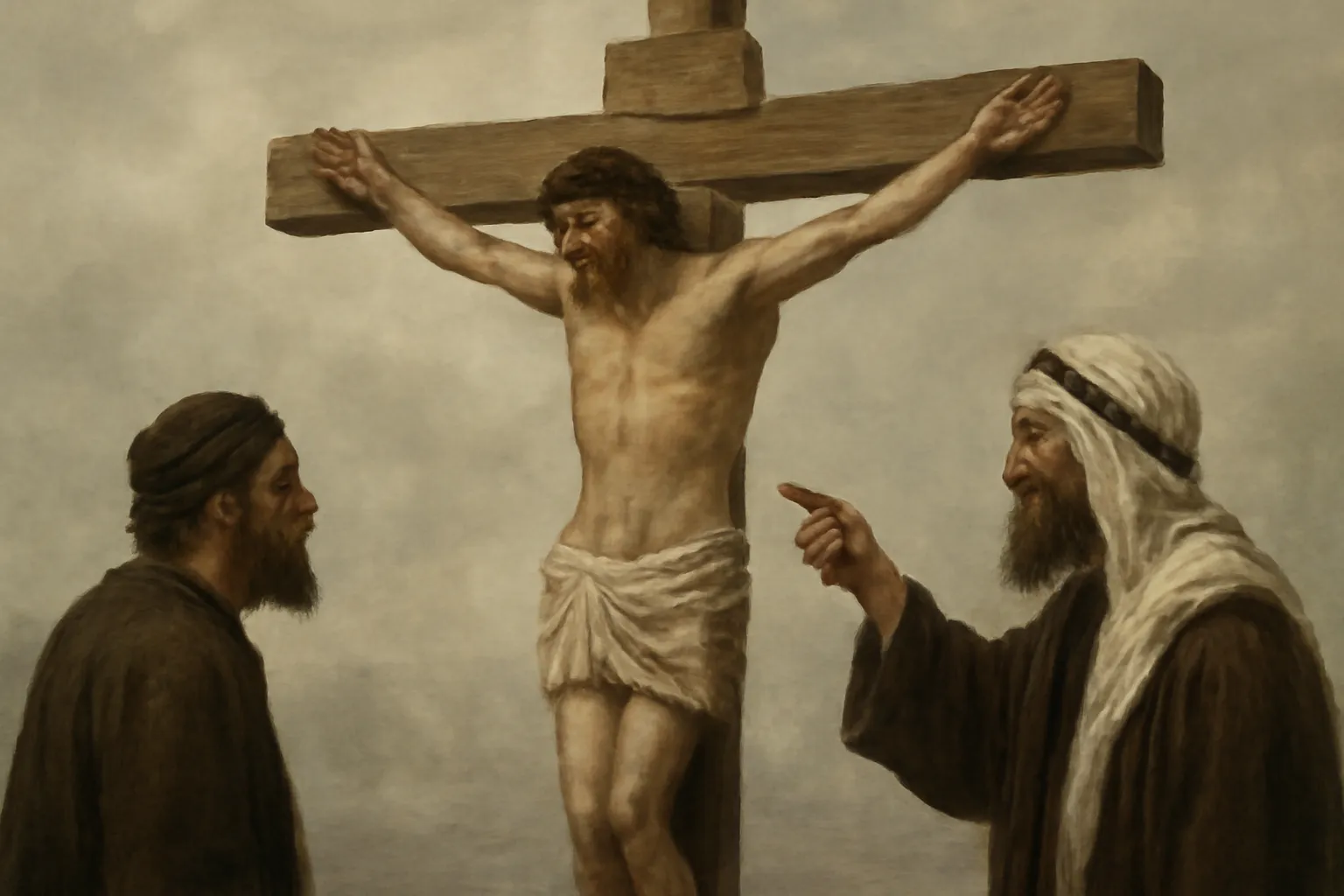
The question of who crucified Jesus has shaped Christian theology, Jewish-Christian relations, and modern debates about history and responsibility for centuries. This article offers a careful, historically grounded, and theologically nuanced analysis of the prompt often framed as Did Jews crucify Jesus? or in variations such as did Jewish authorities crucify Jesus or was Jesus killed by the Jewish crowd. Our aim is to distinguish historical events in first‑century Judea from later theological interpretations and to avoid presenting a single group as the sole actor or scapegoat. By examining the sources, the historical context, and the evolving interpretations across Christian traditions, we can better understand how this question has functioned in religious discourse and how it is approached today in responsible scholarship and interfaith dialogue.
Framing the Question: Was It the Jews Who Crucified Jesus?
In public discourse, the question is often simplified to a binary: the Jews crucified Jesus or the Romans crucified Jesus. In scholarly and theological settings, however, the framing is more precise and historically informed. The crucifixion was a Roman method of execution carried out under the authority of the Roman state, typically executed by provincial governors or Roman soldiers. Yet, within the narrative accounts of the first-century biographies of Jesus, there are also references to Jewish religious authorities and to crowds that interacted with Jesus in the period leading up to the crucifixion. This has led to the frequent formulation of variations such as did Jewish leaders push for Jesus’ death, did some in the Jewish authorities call for crucifixion, or was Jesus condemned by the Sanhedrin and handed over to Pilate.
Because the term “the Jews” in ancient texts can refer to a range of groups and authorities, it is essential to distinguish the historical actors in Jerusalem at the time from modern Jewish communities. The goal of careful scholarship is to understand who acted within the political and legal framework of Roman rule, not to attribute the actions of a few individuals to an entire religious or ethnic group. In that spirit, this article will distinguish historical responsibility, theological interpretation, and ethical implications for contemporary readers.
Historical Context: Roman Rule, Jewish Leadership, and the Crucifixion
To understand the crucifixion of Jesus, one must first grasp the structure of power in first-century Judea. The region was a province within the Roman Empire, under the ultimate authority of the Roman Emperor and the local administration of the governor or procurator. The crucifixion as a practice was employed by Romans to deter dissent and punish crimes deemed in Roman terms as treason or sedition. The act itself was carried out by Roman soldiers and overseen by a Roman official, such as a governor, who had the prerogative to order capital punishment.
Within this framework, Pontius Pilate is the historical figure most often identified in the Gospel accounts as the official who authorized Jesus’ execution. The historical record outside of Christian sources is sparse, but the Roman practice was well established: the governor could authorize crucifixion, and local authorities or the crowd could play a role in the events that led to the order. In the Gospel narratives, there is also mention of Jewish authorities in Jerusalem who confront Jesus, question him, and press for action against him. The question then becomes: did the Jewish leadership first locate Jesus as a political or religious threat, and did they solicit or demand his execution? The answer is complex and varies across sources, but most scholars agree that the Roman authorities bore the ultimate legal responsibility for the crucifixion, under the charge of sedition against Rome.
In terms of the political dynamic, the Sanhedrin, the council of Jewish leadership in Jerusalem, operated under Roman oversight in a manner that allowed them to judge certain matters. Some Gospel passages portray the Jewish leadership as bringing Jesus before Pilate with charges that included challenging Roman authority or claiming to be a king in competition with Caesar. Other voices emphasize that the Jewish authorities were acting under pressure from their community or in response to perceived threats to religious order. The important thing to recognize is that the crucifixion was a Roman act with local Jewish involvement and pressure, not a purely Jewish decision in the sense of a monolithic group making a unified choice for all Jews.
Historical scholarship also takes into account that the occupation context was one in which fear, political calculations, and theological disagreements all intersected. First-century Judea was a highly diverse society, with various groups and factions, including Pharisees, Sadducees, zealots, and others, often disagreeing about how to respond to Roman power and about how to interpret Jewish law and identity under occupation. In this milieu, questions about who was responsible for Jesus’ fate must be handled with care to avoid overgeneralizations about entire communities.
Gospel Narratives: Varying Portraits Across the Canon
The canonical Gospels provide four different, but related, accounts of Jesus’ crucifixion. Each Gospel writer uses different emphases and terms to convey the events, and each places emphasis on different audiences and theological aims. In examining the question at hand, it is helpful to compare how the Gospel narratives frame the roles of Jewish authorities, crowds, and Roman authorities.
Matthew
In the Gospel of Matthew, the narrative presents a sequence in which Jesus is brought before Pilate by several elders, scribes, and the whole council. The charge includes that Jesus claimed to be the Son of God and the king of the Jews. The account also notes the crowd’s shifting attitudes, with Pilate offering to release Jesus, and the crowd choosing Barabbas instead. The emphasis in Matthew includes fulfillment of prophecies and the role of the leaders in pressing for a sentence of death. A key feature is the explicit mention that Pilate finds no guilt in Jesus, yet yields to the demands of the crowd and orders crucifixion. This raises the question of whether the action should be read as Roman political necessity or a reaction to Jewish leadership pressure. The Gospel’s portrayal may contribute to interpretive understandings about how the early Christians viewed Jewish authorities and their involvement.
Mark
In Mark, the narrative moves quickly toward Jesus’ trial and crucifixion. The role of the crowd is present, and there is a strong emphasis on Jesus’ silence before his accusers. The trial scene includes a question about the legality of the sentence and about calling Jesus “the King of the Jews.” Mark stresses the cooperation (or coercion) among various groups, including Pilate, the crowd, and the accusers. The specifics about the involvement of Jewish authorities are presented differently from Matthew, with some emphasis on the political dynamics and the way in which Jesus’ identity as messianic figure is interpreted by authorities and people alike. Mark’s portrayal invites readers to consider how the early Christian community understood the interplay of civic power and religious leadership in the events surrounding the crucifixion.
Luke
Luke’s account emphasizes a broader Samaritan-like perspective of the crowd and the political figures involved. In Luke, Pilate sentences Jesus after a dialogue with the crowd and with the leaders. Luke also includes intriguing details, such as the involvement of Herod in the Jesus affair when Jesus is sent to different authorities, and the portrayal of a more sympathetic crowd. Luke’s narrative adds moral and social dimensions, prompting readers to consider questions of innocence and culpability without painting a monolithic portrait of a single group. The Lucan portrayal underscores the theme of divine providence and fulfillment, while also inviting critical reflection on responsibility for Jesus’ crucifixion.
John
The Gospel of John presents a distinctive trajectory. It emphasizes the role of Jewish authorities and often uses language that has been interpreted as more explicit about the “Jews” seeking Jesus’ death. John’s account places emphasis on Pontius Pilate’s decision and on the broader implement of the crucifixion as a means to reveal “the hour” of Jesus. Some readers have noted that John’s Gospel uses the term the Jews in ways that reflect intra-Jewish–Roman tensions of the period, and not as a blanket condemnation of all Jewish people. The Johannine narrative foregrounds theological themes about light and darkness, testimony, and Jesus’ identity as the Son of God, which can influence how readers understand the culpability narrative within the text.
Across these four Gospels, the shared event of the crucifixion is depicted with differences in emphasis and the portrayal of actors involved. A central takeaway for readers should be that the act of crucifixion was ordered by Roman authorities, and while Jewish leadership figures appear in the narratives, their exact roles, motivations, and the extent of their influence differ from one Gospel to another. When scholars speak of the role of Jewish leaders in Jesus’ death, they typically refer to certain members of the Jerusalem leadership under Roman supervision rather than a universal statement about all Jews. This nuance is essential in avoiding generalizations that contribute to anti-Judaism or antisemitism.
Beyond the historical recounting, the crucifixion has been interpreted in various theological frameworks. The central Christian claim is that the death of Jesus has salvific significance, but the way this is articulated has evolved over time and across traditions.
Early Christian Theologies and Atonement
In early Christian thought, the crucifixion is often read as a atonement for humanity’s sins, a passage from death to life through Jesus’ sacrificial death and resurrection. The form this atonement takes has many strands, including symbolic substitution, ransom theory, and moral influence, among others. The language that appeals to a collective guilt tends to be controversial when separated from historical context. Modern scholarship emphasizes that early Christian communities wrestled with understanding Jesus’ death in light of Jewish law, Roman politics, and the meaning of Messiah in a world under occupation. Theologically, the crucifixion is thus a convergence of public and cosmic dimensions: a public execution by Rome with a transcendent interpretive frame in the Christian proclamation of salvation.
The Language of “the Jews” and Anti-Judaism
Historically, some Christian writings used the phrase “the Jews” or “the Jews’ leadership” to describe responsible actors for Jesus’ death. Over time, this language contributed to anti-Jewish attitudes and stereotypes, culminating in the devastating forms of persecution in the medieval and modern eras. In response, many Christian theologians and denominations have condemned the misuse of biblical language that assigns collective blame to Jewish communities. The Second Vatican Council’s Nostra Aetate (1965) explicitly rejected the idea that Jewish people as a whole were responsible for Jesus’ death and affirmed the enduring covenant between God and the Jewish people. It is now widely understood in ecumenical and academic circles that responsibility rested with a limited set of authorities under Roman authority, and not with the entire Jewish people.
Modern Catholic and Protestant Responses
In modern Christian theology, there is a broad consensus that the crucifixion must be understood within its historical moment and read with care to avoid injuring contemporary Jewish communities. Key points include:
Rejecting collective guilt of all Jews for Jesus’ death.
Acknowledging the historical reality that the Roman state carried out the execution.
Recognizing the role of specific leaders and authorities in Jerusalem, not the whole Jewish people.
Promoting historical study and interfaith dialogue to combat antisemitism and misinformation.
Historical Responsibility and Community Reflection
When discussing the culpability for Jesus’ crucifixion, it is important to distinguish historical facts from theological interpretations, and then from ethical implications for present-day readers. The historical record, as reflected in the Gospel accounts and limited independent sources, points to a scenario in which:
The Roman authorities held legal authority over capital punishment and ordered the execution in response to charges of sedition or threat to Rome’s authority. The exact legal rationale can vary by Gospel; in each case, the official act of crucifixion is a Roman act of execution.
Some members of the local Jewish leadership are depicted as pressing for action against Jesus, often within the framework of Jewish legal and religious concerns or political pressures under Roman oversight. The nature and extent of their influence are debated among scholars and differ across Gospel texts.
Certain crowds or groups within Jerusalem are described as reacting to Jesus in ways that influenced the pace and outcomes of judgment. The emphasis in the texts is not a simple uniformity but a complex social dynamic.
From a modern ethical and historical standpoint, it is critical to avoid imputing collective guilt to contemporary Jewish communities for events that occurred in a distant historical context. Doing so has historically contributed to prejudice and violence. Responsible scholarship and teaching strive to present a balanced picture: a Roman instance of capital punishment in a charged political atmosphere, with involvement from local authorities, and within a diverse urban setting of first-century Judea.
Modern Implications: Anti-Semitism, Interfaith Dialogue, and Education
The question of who crucified Jesus carries significant implications for contemporary interfaith relations. When the discussion is framed in a way that emphasizes collective blame, it can fuel anti-Semitic stereotypes and discrimination. Conversely, a careful, historically grounded approach can foster mutual understanding and respect between Jewish and Christian communities. Some practical implications include:
Educating audiences about context to avoid broad generalizations about people or faiths.
Promoting interfaith dialogue that centers on shared ethics, historical awareness, and mutual respect.
Encouraging scholarly editions and commentaries that clearly distinguish historical events from theological interpretations.
Addressing theological claims about atonement in ways that are sensitive to Jewish interpretations of scripture and to Christian ecumenical learning.
In contemporary discussions, readers are encouraged to engage with multiple perspectives, including:
Historical-critical studies that weigh the sources, their dates, and their audiences.
Modern theological reflections that interpret the crucifixion in light of Christian doctrine while avoiding the invitation to hatred or exclusion.
Pastoral and educational efforts that emphasize reconciliation, justice, and the dignity of all people.
Variations of the Question: Other Phrasings and Their Nuances
To reflect the semantic breadth of this topic, scholars and educators often encounter a variety of formulations, all seeking to understand the same historical event from different angles. Some common variations include:
Did Jewish authorities advocate Jesus’ execution? — Focuses on the actions of Sanhedrin or high priests as described in some sources.
Was Jesus condemned to death by the crowd? — Emphasizes social pressure, mob dynamics, and communal response.
Who ordered the crucifixion? — Highlights the Roman legal authority and Pilate’s role in the process.
Who bears responsibility for Jesus’ death? — Encourages discussion of shared and contested accountability among actors, including Romans and certain Jewish leaders, without indicting entire communities.
How do different Gospel writers depict the crucifixion? — Invites analysis of literary genre, theological aims, and historical memory across Matthew, Mark, Luke, and John.
These variations help readers examine the event from multiple angles and avoid simplistic conclusions. In academic settings, it is standard to anchor such discussions in primary texts, historical context, and responsible interpretation that respects the integrity of Jewish communities and the integrity of Christian faith traditions alike.
A Nuanced Understanding
The question “Did Jews crucify Jesus?” cannot be answered with a simple yes or no that names a single group. The best conclusion—supported by historical, textual, and theological scholarship—is that Jesus’ crucifixion was carried out under Roman authority, with involvement of certain local leaders and factions within Jerusalem, and with the participation of a crowd in some of the Gospel accounts. It is crucial to preserve nuance: this is not a condemnation of the Jewish people as a whole, nor is it simply a Roman affair unconnected to Jewish life in the first century. The historical record shows a complex interplay of political power, religious leadership, and communal dynamics under occupation.
From a theological perspective, the crucifixion has been interpreted within Christian frameworks as a event with salvific significance, but modern scholarship and ecumenical dialogue stress the importance of reading this event in context and avoiding language that assigns collective guilt to contemporary Jewish communities. The trajectory of Christian thought in the 20th and 21st centuries—especially through initiatives like Nostra Aetate—has moved toward greater mutual respect, historical honesty, and a commitment to combating antisemitism in all its forms. By approaching the topic with careful attention to historical context, textual variation, and ethical responsibility, readers can gain a richer, more accurate understanding of a difficult and deeply consequential question.
In sum, the question can be reframed as: What do historical sources say about the actors who ordered and carried out the crucifixion, and how have different communities interpreted that event over time? The responsible answer recognizes Roman authority as the legal actor for the execution, notes the involvement of certain Jewish leadership figures as depicted in the Gospel accounts, and upholds a moral stance that rejects the idea of blanket blame on the Jewish people. This nuanced stance helps foster better historical understanding, more accurate theology, and healthier interfaith relationships for today.