Boaz & Ruth in the Bible: Their Story, Significance, and Lessons
The story of Boaz and Ruth is one of the most evocative narratives in the biblical record. It unfolds in the books of Ruth and intersects with the larger story of Israel’s history in ways that scholars and readers continue to find rich and instructive. Although the two figures are introduced in a small book, their influence radiates far beyond their immediate circumstances. They illustrate themes of loyalty, providence, social justice, and the way God works through ordinary people to accomplish extraordinary ends. This article surveys Boaz and Ruth—their story, their significance, and the enduring lessons they offer for readers today.
The Story of Ruth and Boaz: A Narrative Overview
To understand the place of Boaz and Ruth in the biblical canon, it helps to situate them within their historical setting. The book of Ruth is set during the time of the judges, a period when Israel faced both internal challenges and external pressures. The narrative centers on hardship, exile, and a return to the homeland, but it is ultimately a tale about faithfulness and how the faithful God acts through faithful people.
Ruth the Moabite: Loyalty Beyond Boundaries
Ruth is introduced as a Moabite woman who chooses to remain with her mother-in-law Naomi after the deaths of Naomi’s husband and sons. Naomi urges Ruth to return to her own family, yet Ruth responds with a declaration that has become famous for its stirring commitment: “Where you go I will go, and where you lodge I will lodge. Your people shall be my people, and your God my God” (Ruth 1:16–17, ESV). This statement is not merely a personal vow; it signals a relocation of allegiance—from a foreign land to the God of Israel and His people. Ruth’s decision is remarkable in part because it crosses ethnic and religious boundaries, highlighting a humility and courage that astonish the reader over time.
Boaz the Bethlehemite: A Portrait of Generosity and Lawful Kindness
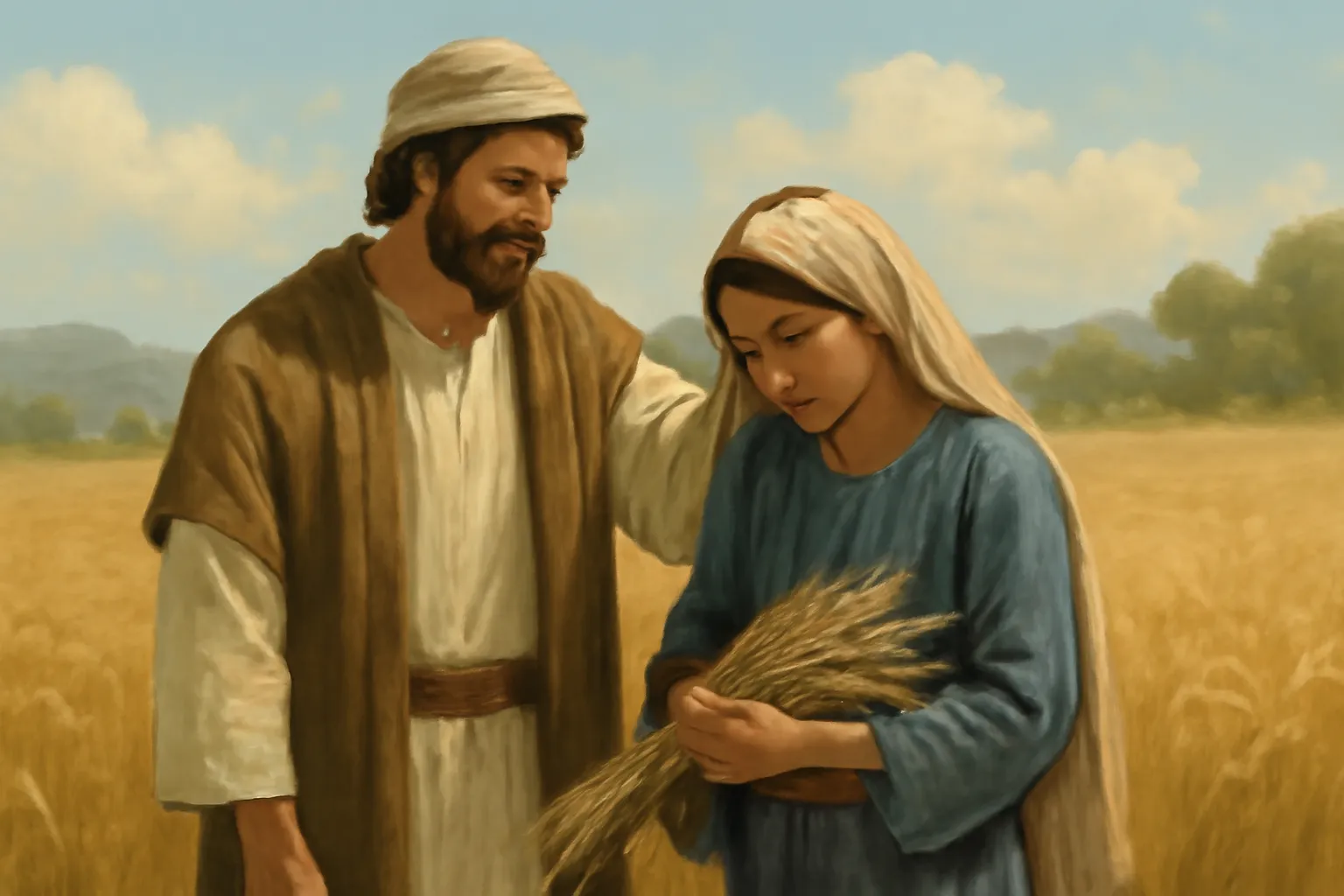
Boaz, identified as a wealthy landowner and the “kinsman-redeemer” in the Ruth narrative (though the exact legal process unfolds with a closer relative), embodies a countercultural form of virtue. He is “a man of standing” who notices Ruth in the fields as she gleans grain to provide for Naomi’s household (Ruth 2). The act of gleaning—where the vulnerable could collect leftover grain—dramatizes social vulnerability but also provides a setting for Ruth’s integrity to shine. Boaz’s treatment of Ruth is not merely chivalrous; it is grounded in a responsibility toward the vulnerable that is consistent with ancient Near Eastern law and ethics. He ensures Ruth’s safety among the laborers, offers her protection, and extends generous provisions, saying, “Let her glean even among the sheaves; do not rebuke her” (Ruth 2:7, NIV). In this way, Boaz demonstrates practical compassion and rightful use of power.
The Meeting at the Threshing Floor: An Act that Requires Discernment
The turning point comes when Ruth, guided by Naomi’s plan, approaches Boaz at the threshing floor at night and asks him to act as her “redeemer” according to the law of Israel. The scene is intimate and culturally charged, with Ruth requesting protection and Boaz affirming his readiness to help, provided a closer relative does not outrun him in the process (Ruth 3). The threshing-floor episode is often read as a moment of bold faith, a test of trust in God’s timing, and a concrete step toward securing Ruth’s safety and Naomi’s lineage.
The Legal Transaction and the Marriage: A Lineage Secures a Future
The story reaches its legal culmination in Ruth 4, where Boaz goes to the gate of the town and meets the closer relative who has first claim to Naomi’s family property and Ruth’s future. After the closer relative relinquishes his rights, Boaz publicly proclaims his desire to redeem, marry Ruth, and preserve the family line. The transaction is sealed with witnesses and a consummation of marriage, resulting in Ruth becoming the wife of Boaz. Their son, Obed, would become the grandfather of David, placing Ruth in the genealogical Ancestry of the royal line and, by extension, the messianic line traced in later biblical texts.
Theological and Social Significance: Why Ruth and Boaz Matter
The narrative of Boaz and Ruth is not merely a personal romance or a family drama; it sits at the intersection of law, society, and divine purposes. The story illuminates several enduring themes within biblical theology and ethics.
Inclusion and Covenant Faithfulness: The Moabite Woman in Israel’s Story
One of the most striking elements of Ruth’s story is the inclusion of a foreign woman in the people of God. The text repeatedly emphasizes Ruth’s commitment to Naomi and to Naomi’s God, culminating in Ruth’s declaration of faith. This inclusion foreshadows the broadening of Israel’s covenant community beyond ethnic boundaries and hints at a future in which the God of Israel is known among all peoples. The book presents a countercultural claim: loyalty and piety are not limited to native-born Israelites but are accessible to those who turn toward the God of Abraham, Isaac, and Jacob.
Kinsman-Redeemer: The Law in Action
The figure of Boaz embodies the biblical concept of the kinsman-redeemer, or goel, a person who has the obligation to redeem a relative in danger or distress—whether by reclaiming land, marrying a widow to preserve the family line, or restoring legitimate inheritance. Boaz’s willingness to fulfill this role for Ruth and Naomi demonstrates how the law that protects vulnerable family members can be enacted with mercy and justice. This is not merely a legal formality; it is a living expression of community responsibility that safeguards the vulnerable and preserves the continuity of the lineage.
Providence in Human Action: God at Work in Ordinary People
Readers and theologians have long observed that the book of Ruth presents a view of divine providence that operates through ordinary people and ordinary moments. While God’s name is not overtly invoked in every scene, the text consistently highlights how a series of decisions— Ruth’s loyalty, Boaz’s kindness, the closer relative’s compliance, and Naomi’s guidance—converge to produce a lineage that becomes central to the nation’s history. This underscores a biblical conviction: God works through faithful acts, even when they occur outside the spotlight of overt miracles. The story encourages readers to trust in God’s purposes amid everyday circumstances and to recognize that personal virtue, communal obligation, and divine intention are not mutually exclusive but mutually reinforcing.
Gender and Narrative Voice: Women at the Center
In Ruth and Boaz, women occupy central roles in advancing the plot and shaping outcomes. Ruth’s steadfast loyalty and Boaz’s prudent generosity give readers a nuanced view of gender dynamics in ancient Israel. The narrative centers female choices and their impact on the male guardianship system, while also acknowledging the social protections afforded to women through the law and communal norms. The story has been celebrated in various traditions for elevating the dignity and agency of Ruth and Naomi, who navigate hardship with courage and wit. The portrayal invites modern readers to reflect on how women’s voices contribute to the integrity and resilience of communities.
Ruth and Boaz in the Canon: Genealogy, David, and the Messianic Line
The final chapters of Ruth connect deeply to the broader biblical storyline. The book closes with a genealogical record that traces Ruth’s descendants: Ruth becomes the mother of Obed, Obed the father of Jesse, and Jesse the father of David (Ruth 4:18–22). This genealogical insight places Ruth inside the dynastic line of the kings of Israel, highlighting how a Moabite woman’s faithfulness becomes a crucial thread in the tapestry of Israel’s history. In the Christian tradition, the genealogies of Jesus in the Gospel of Matthew echo this line, noting Ruth among those who contribute to the genealogy of Christ (Matthew 1:5–6). Thus, Ruth’s story serves as a bridge—from the fields of Bethlehem to the throne of Israel, and, in the Christian perspective, to the messianic fulfillment fulfilled in Jesus.
Across Jewish and Christian traditions, Ruth and Boaz have been read through multiple interpretive lenses. Each lens sheds unique light on their story and its implications for faith and life.
In some rabbinic interpretations, Ruth’s willingness to leave Moab and adopt Naomi’s God represents an exemplary model of conversion and devotion to Israel’s God. Her action is celebrated as a model of steadfast righteousness that transcends ethnic boundaries.
The Boaz–Ruth narrative has been discussed in the context of kindness and social justice, illustrating how the law is meant to protect the vulnerable and how generosity can be a form of worshipful obedience to God’s commands.
Christian Theological Reflections
Christians have often highlighted Ruth’s inclusion in the genealogy of David and ultimately in the lineage of Jesus as evidence of God’s inclusive plan for humanity. Ruth’s story is cited as a precedent for Gentile inclusion in God’s redemptive work.
The teeming theme of redemption resonates with Christian ideas of salvation as a form of divine rescue that comes through faith, faithfulness, and the rightful securing of lineage and blessing.
Beyond its ancient setting, the Ruth and Boaz narrative offers enduring lessons that readers can apply in contemporary life. These insights touch on ethics, community, leadership, and spiritual formation.
Lessons in Character and Virtue
Loyalty and steadfastness: Ruth’s allegiance to Naomi is a model of long-term loyalty that transcends personal cost. The decision to remain with Naomi, to travel to a land unfamiliar and to adopt a new faith, reflects a depth of commitment that is rare and worthy of imitation.
Generosity and protection: Boaz’s actions toward Ruth demonstrate how power and wealth can be exercised to safeguard vulnerable members of society. His careful attention to Ruth’s welfare—protection in the fields, command against mistreatment, and generous provision—offers a pattern for governance and leadership grounded in care for others.
Lessons in Faith Under Providence
Trusting God’s timing: The sequence from Ruth’s demand for security to Boaz’s legal action unfolds over weeks and months. The story is a reminder to trust God’s timing, even when plans face regulatory or social obstacles.
Seeing God in ordinary life: The book invites readers to recognize that God’s fingerprints appear in everyday acts of kindness, courage, and fidelity. The mundane moments—gleaning in the fields, negotiating at the town gate, and keeping promises—are where God’s purposes often take shape.
Lessons in Community and Law
Law as a framework for mercy: The goel concept shows how legal structures are meant to protect vulnerable family members and ensure the continuity of households and land stewardship. When combined with compassion, the law becomes a vehicle for justice.
Inclusion as a virtue of the people of God: Ruth’s story invites communities to welcome outsiders, to honor commitments, and to cultivate a society where foreign-born individuals can become part of the commonwealth through faith and deeds that align with righteous living.
The significance of Boaz and Ruth extends beyond their own era. The narrative contributes to the biblical arc by highlighting how God’s promises are carried forward through real families with real choices. The story sits confidently within the wider biblical drama—the exodus, settlement in Canaan, covenant faithfulness, and the unfolding of a royal lineage that culminates in messianic expectations in Christian readings. The inclusion of Ruth in this lineage underscores a theological conviction that God’s covenant faithfulness reaches across cultures and time to accomplish redemptive ends.
As modern readers, we are invited to reflect on the moral imagination the Ruth–Boaz narrative awakens. It challenges us to ask: How do we respond when we encounter vulnerability? How can wealth and influence be used to extend justice rather than secure advantage? And what does it mean to trust God when human plans require patience and humility? The story of Boaz and Ruth provides not only historical or religious insight but also practical wisdom for living with integrity in a complex world. It is a testament to the way faithful hearts, anchored in God’s purposes, can shape families, communities, and even the course of history.
One of the most striking elements of Ruth’s story is its afterlife in Israel’s royal memory. By making Obed, Jesse, and David part of Ruth’s genealogy, the narrative asserts that a foreign woman’s virtue can contribute to the founding of a line that becomes central to the national identity and destiny. The reader can perceive this as more than a genealogical footnote; it is a theological statement about inclusion, blessing, and the manner in which God’s promises unfold through human history.
Boaz is described as a respected man of standing from Bethlehem, a guardian who acts with integrity toward Ruth.
Ruth emerges as a model of devotion, faith, and courage, known for her famous vow and her role as a daughter-in-law who becomes a matriarch.
The setting includes Bethlehem, a town whose name later carries liturgical and messianic significance in both Jewish and Christian traditions.
The law’s mechanism of the kinsman-redeemer provides the framework for Boaz’s actions and the ultimate securing of Ruth’s future.
The narrative culminates in a line that runs directly to the throne of David, thus linking a foreign woman to the heart of Israel’s royal and spiritual history.
The story of Boaz and Ruth continues to resonate because it speaks to universal concerns—family loyalty, social justice, and the possibility of transformation through faithfulness. It is a story of risk taken for the sake of others, of a society choosing to welcome the vulnerable, and of a people learning to trust in a God who remains at work through ordinary people in extraordinary ways. Whether read as a historical narrative, a theological meditation, or a moral parable, Ruth and Boaz invite readers to consider how courage, generosity, and covenant fidelity can shape personal lives and the collective memory of a nation. In the end, their legacy is not merely a line in a genealogical record but a living reminder that the best legacies arise when persons, with courage and care, participate in God’s ongoing work in the world.