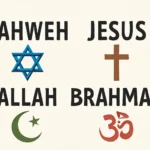
Names of God are not just labels; they are windows into how communities understand the divine mystery. Across languages, cultures, and religious traditions, people have given many names to the one, eternal reality they worship. In this article, we explore Names of God and their meanings, from ancient Hebrew terms to Arabic, Sanskrit, and beyond. We will also speak in Spanish briefly where helpful, as the phrase Nombres de Dios y sus significados signals a bilingual invitation to reflection on how names shape devotion, prayer, and daily life.
Names of God / Nombres de Dios y sus significados: a survey of terms and contexts
In many traditions, a name for God carries a particular attribute or function—justice, mercy, creation, sustainment, or transcendence. Some names are used predominantly in liturgy, others in poetry, others in everyday speech and private meditation. The same divine name can carry different shades of meaning in different communities, and some names have evolved in their pronunciation or usage over centuries. Below is a broad, informative overview that respects linguistic variety while highlighting core ideas about what these names convey.
Key names in the Hebrew Bible / Tanakh and their meanings
YHWH (יהוה) — The Tetragrammaton: the personal name of Israel’s God
The four Hebrew letters יהוה, often rendered in English as YHWH, represent what many scholars call the Tetragrammaton. In Jewish tradition, the personal name of God is considered too sacred to be spoken aloud; when reading scripture, readers say Adonai (the Lord) or HaShem (the Name) instead. In scholarly and many English-language contexts, the form Yahweh is a widely accepted reconstruction of the original pronunciation, though the precise vocalization remains uncertain.
Meaning: often described as “the Self-Existent One” or “I am who I am,” emphasizing God’s eternal, uncreated presence.
Usage: appears in the Hebrew Bible as the personal name of the God of Israel; its reverent use shapes theological and liturgical interpretation.
Elohim — God in the Hebrew Bible
Elohim is a plural-sounding form that appears with singular verbs when referring to the God of Israel. This has sparked much discussion among scholars, who often emphasize that the form can be understood as a majestic, all-encompassing title rather than indicating a numeric plurality.
Meaning: “God” or “gods,” depending on context; in biblical usage it most often designates the singular, supreme God.
Usage: used at the start of the creation narrative and in many other key passages to refer to the divine creator and ruler.
El Shaddai — God Almighty
El Shaddai translates roughly as “God Almighty” and appears in biblical poetry and narrative. The exact etymology remains debated, but the sense is of supreme, all-sufficient power and protection.
El Elyon — God Most High
El Elyon means “God Most High,” highlighting the sovereignty and exalted status of the divine over earthly powers and rival gods described in various texts.
El Olam is the name signifying eternity—an aspect of God that transcends time and creation’s finite lifespan.
Tzevaot — The Lord of Hosts
Tzevaot (often rendered “Hosts” or “Armies”) emphasizes God’s sovereignty over heaven’s armies and the cosmic order. It is frequently paired with YHWH in prophetic books and liturgy.
Adonai — Lord (as a spoken substitute for YHWH)
In Jewish practice, Adonai is spoken aloud in place of the sacred name YHWH during readings. The term conveys authority, lordship, and intimate relationship with God.
Ehyeh Asher Ehyeh — “I am who I am” (the divine self-description)
The phrase Ehyeh Asher Ehyeh appears in Exodus 3:14, spoken when Moses asks for God’s name. It is often rendered I AM WHO I AM and signals God’s self-sufficiency, presence, and unchanging nature.
Names in Christian tradition / Names used in worship and devotion
Jehovah / Yahweh — traditional Christian renderings of YHWH
Christians historically used the Latinized form Jehova (or Jehovah) in Bible translations, though modern scholarship commonly favors Yahweh as a closer representation of the original Hebrew pronunciation. In hymnody and devotional literature, the older form remains familiar to many readers and worshippers.
Meanings and uses: as the personal name of God, it signals relationship, faithfulness, and the divine presence with God’s people.
Related epithets: throughout biblical narrative, God is invoked with compound names that describe actions or promises (e.g., Jehovah Jireh, Jehovah Nissi, Jehovah Shalom).
Common compound epithets: Jehovah Jireh, Nissi, Shalom, Tsidkenu, and others
In Christian liturgy and scripture, several compound names of God express particular redemptive acts or divine character in relation to people’s lives:
Jehovah Jireh — “the Lord will provide”
Jehovah Nissi — “the Lord is my banner”
Jehovah Shalom — “the Lord is peace”
Jehovah Tsidkenu — “the Lord our righteousness”
Jehovah Mekoddishkem — “the Lord who sanctifies you”
These names are frequently encountered in Christian poetry, sermons, and devotional books, sometimes adapted to English rendering to fit the cadence of worship music and prayer.
I Am — the divine self-revelation in Christian and Jewish contexts
The terse expression I AM (from the same biblical root as Ehyeh) is echoed in Christian tradition as a direct identification of God’s self-existent presence. In Christian devotional practice, I Am can appear in reflections on Christ’s divine identity as well, where the concept of God’s timeless presence is foregrounded in theology and personal meditation.
Names of God in Islam and Arabic tradition / Names for the One God in the Arabic-speaking world
Allah — The One God
In Islam, Allah is the Arabic word for God, used by Muslims and Arabic-speaking Christians alike to denote the divine in the most general sense as well as the personal God of revelation. The term emphasizes the unity and transcendence of God in monotheistic thought.
Asma’ al-Husna — The 99 Names of Allah
Muslims often speak of Asma’ al-Husna (The Most Beautiful Names), a traditional list of 99 attributes of God that describe qualities such as mercy, power, wisdom, and justice. Some commonly cited names include:
Ar-Rahman — The All-Merciful
Ar-Rahim — The Most Compassionate
Al-Malik — The King
Al-Quddus — The Holy
Al-Aziz — The Mighty
Al-Hakeem — The Wise
Al-Khaliq — The Creator
Al-Razzaq — The Provider
Al-Gaffar — The Forgiving
The 99 Names invite believers to reflect on different facets of God’s nature and to cultivate corresponding attitudes in daily life, prayer, and ethics. They are often recited in supplication (du’a) and memorized as part of spiritual formation.
Theological note on usage
In Islamic practice, invoking Allah with respectful awareness of the attributes conveyed by the 99 Names helps believers frame their understanding of God’s relationship to creation. The names are not separate deities; they are manifestations of one coherent divine essence, described through human language that gestures toward mystery beyond words.
Names of God in Hinduism and other Dharmic traditions / Epithets for the divine in India
Brahman — The ultimate reality
In Hindu philosophy, Brahman is the ultimate, formless reality that underlies all existence. It is described in two main ways: Nirguna Brahman (without attributes) and Saguna Brahman (with attributes). These terms reflect a spectrum from the impersonal absolute to the personal gods who are manifestations of the same ultimate principle.
Ishvara, Narayana, Krishna, Shiva, Shakti — diverse names for the divine
Hinduism embraces a vast pantheon, with many names for the divine, each signaling a distinct facet or function. Some commonly encountered names include:
Ishvara — the Lord, a personalizing principle
Narayana — a name associated with Vishnu, the preserver
Vishnu — the Sustainer, with many avatars
Rama — an avatar of Vishnu, symbolizing righteousness and virtue
Krishna — a beloved avatar of Vishnu, renowned for compassion and cosmic play
Shiva — the destroyer and transformer, part of the Trimurti
Shakti — the divine feminine energy, often personified as Durga, Kali, or Parvati
Om / Aum — the primal syllable that encodes the cosmic vibration of the universe
In devotional practice, many Hindus chant the divine name as a form of Nam japa (repetition of the name) or as part of mantras. The practice highlights an intimate relationship with the divine through sound, rhythm, and contemplation.
Paramatma and Saguna–Nirguna distinctions
Two important doctrinal notions help organize Hindu thought about the names of God. Paramatma refers to the “Supreme Soul” that dwells within all beings, while Saguna Brahman and Nirguna Brahman refer to God with attributes and God beyond attributes, respectively. This framework allows for both personal devotion (lila, bhakti) and philosophical inquiry (advaita, vishishtadvaita).
Names used in regional and folk traditions
In addition to the major scriptures, Hinduism includes countless local names and epithets tied to temples, tastes of devotion, and regional lore. Names such as Rama, Gaṇeśa (Ganesha), Durga, and Kali appear in temples, songs, and daily rituals, each carrying a narrative of divine love, protection, and cosmic order.
Names and epithets in Sikhism / Waheguru and related concepts
Waheguru — The Wonderful Teacher
In Sikhism, the divine name Waheguru is a central focal point of meditation and devotion. It is often translated as “Wonderful Teacher” or “Wondrous Lord” and embodies the ecstatic experience of the divine presence within the heart.
Ik Onkar and Satnam — Oneness and true Name
Sikh thought emphasizes the unity of God with phrases like Ik Onkar (One Creator) and Satnam (True Name). These concepts frame prayer, ethics, and community life around a single, indivisible divine reality.
Names for practice: how names of God appear in worship and daily life
In liturgy and creeds
Across Christian, Jewish, Muslim, Hindu, and Sikh communities, names of God appear in liturgical texts, creeds, and prayers. The arrangement often reveals theological priorities: sovereignty and mercy in Christian hymns; unity and transcendence in Islamic prayers; creation and sustenance in Hindu bhakti songs; and personal relationship in Jewish liturgy.
In sacred art and architecture
Names of God are inscribed in script, carved in stone, or painted in religious art. The appearance of a name in a temple, synagogue, mosque, or church signals the sacred presence and invites contemplation. Some communities reserve the most sacred names for private reflection, while others render a broad array of epithets in public devotion.
In education and scripture study
Scholars, teachers, and devotional leaders often organize study around particular names and their contexts. This helps learners understand how language reflects theology, how translations influence interpretation, and how different faith traditions approach a shared mystery through their own linguistic lenses.
Practical considerations: using the names of God with respect and accuracy
Language, translation, and transliteration
Names move across languages and scripts, and pronunciation may shift with time and region. When engaging with a name, it is helpful to note:
The original language (Hebrew, Arabic, Sanskrit, Punjabi, etc.).
How translators choose to render the name in a given text.
Whether a community uses a formal, reverent form in worship or a more everyday usage in personal prayer.
Respectful usage in interfaith dialogue
When discussing the names of God in pluralistic settings, it is wise to distinguish between names for the divine and the many theologies that attribute ultimate reality to one God in different ways. Acknowledging the sacredness of each tradition helps foster mutual respect and thoughtful conversation.
In private devotion, a believer may choose a name that resonates personally. In academic study, scholars may emphasize linguistic origins, textual contexts, and historical development. In interfaith dialogue, it is often best to present names with their meanings and the values they convey, rather than asserting a single correct pronunciation or interpretation for all readers.
How to approach learning about God’s names: a learning guide
Start with core names: YHWH / Yahweh, Elohim, Allah, Brahman, Waheguru, and Ishvara. Understanding these core names builds a solid foundation for broader study.
Note the context: when and where a name appears, whether as a title, a description, or a personal identifier.
Learn the variations: transliterations differ (YHWH vs Yahweh vs Jehovah), as do the compound forms (Jehovah Jireh, Jehovah Nissi, etc.).
Cross-reference meanings: compare how a name’s meaning appears in scripture, liturgy, and devotional poetry across traditions.
Practice reverent usage: adopt appropriate forms in personal study or dialogue, and avoid casual or disrespectful usage.
Why names matter: impact on faith practice and identity
Names of God function as theological anchors and objects of meditation. They help believers articulate the character of the divine—whether as the Creator who brings order out of chaos, the merciful sustainer who remembers the afflicted, or the personal presence who accompanies the faithful through ordinary life and extraordinary events. In many traditions, naming God is also an act of naming the good to which a person aspires. When a believer repeats a divine name, the practice can become a doorway into trust, gratitude, courage, and endurance.
Synthesis: what we gain by studying the diverse names
Exploring Nombres de Dios y sus significados across traditions clarifies both unity and diversity within human religion. On one hand, the array of names points toward a single mystery greater than any single description. On the other hand, the distinctive names reveal the richness of human language and imagination in addressing the divine. By comparing names such as YHWH, Allah, Brahman, and Waheguru, we see how faith communities encode their deepest convictions about reality, relationship, and purpose into words that guide worship, ethics, and daily life.
embracing a respectful and informed approach to divine names
Names for God are more than historical artifacts; they are living elements of belief that shape prayer, art, philosophy, and community norms. This article has offered a broad tour of some of the most influential names and their meanings—ranging from the Tetragrammaton in the Hebrew Bible to the Asma’ al-Husna in Islam, from Brahman in Hindu thought to Waheguru in Sikh devotion. Readers are invited to appreciate the beauty and depth of these names while maintaining respect for the contexts in which they arise. Whether you are a student of religion, a seeker of spiritual language, or a person curious about how communities speak of the divine, the names of God offer a compelling doorway into the many paths people walk toward truth, meaning, and transcendence.