All the Names for God: A Complete Guide to Divine Names surveys how cultures, faiths, and languages imagine the divine through titles, epithets, and personal names. Names are more than labels; they encode attributes, relationships, and moments of encounter. This article traces a broad panorama of divine names across major traditions, explains how those names function in worship and reflection, and offers practical guidance for recognizing the semantic breadth behind each form. Throughout, key names are highlighted to reflect their significance and the ways they are used in prayer, liturgy, and study.
Because traditions differ in theology, language, and historical development, the same name may carry different nuances in different communities. Similarly, many languages render the same concept with variations in spelling and pronunciation. The aim here is not to prescribe a single canonical list, but to provide a comprehensive, cross-cultural guide to the most influential and widely used names for God, with attention to meaning, usage, and context. The result is a resource you can consult for study, comparative religion, or personal reflection.
Overview: why names matter in theology and daily devotion
The names given to the divine serve several overlapping purposes. First, they express attributes such as omnipotence, mercy, justice, or transcendence. Second, they encode a specific relationship between the believer and the divine—creator, sustainer, savior, guide, judge. Third, they shape liturgy and prayer, guiding what is asked for or celebrated in worship. Finally, names invite contemplation: by naming God in different ways, communities reflect on the fullness of the divine reality, including mystery that exceeds any single description.
Because language itself is culturally shaped, readers should approach divine names with both reverence and curiosity. Some names are sacred in one tradition but not used in others; some names have multiple forms or transliterations; some carry historical layers that reveal how a people understood God across centuries. This guide presents a structured walk through major families of names, starting with the Judeo-Christian tradition, moving to Islam, then to Hindu and other Indian traditions, and finally to broader linguistic and theological categories.
Names for God in the Judeo-Christian tradition
In the Jewish and Christian worlds, Hebrew roots provide many of the most influential divine names. Each name often carries a layered history of revelation, encounter, and liturgical use. The following list highlights common names, their core meaning, and how they are typically used in worship or scripture. Variants and transliterations are noted where they commonly appear in English translations.
Key Hebrew names and core meanings
Yahweh (often rendered in print as YHWH): the personal name of the God of Israel, traditionally translated as “I Am” or “I Am Who I Am”. This represents God’s self-existence and eternal presence, and it appears in many biblical passages as the basis for other titles and for God’s creative and redemptive actions.
Adonai — commonly used in Jewish liturgy to refer to God as “My Lord”; serves as a respectful substitute for the divine name in spoken prayer.
Elohim — literally a plural form often used with singular verbs to mean “God” in the sense of the supreme, sovereign Creator. The word appears prominently in the Creation narratives and many Psalms.
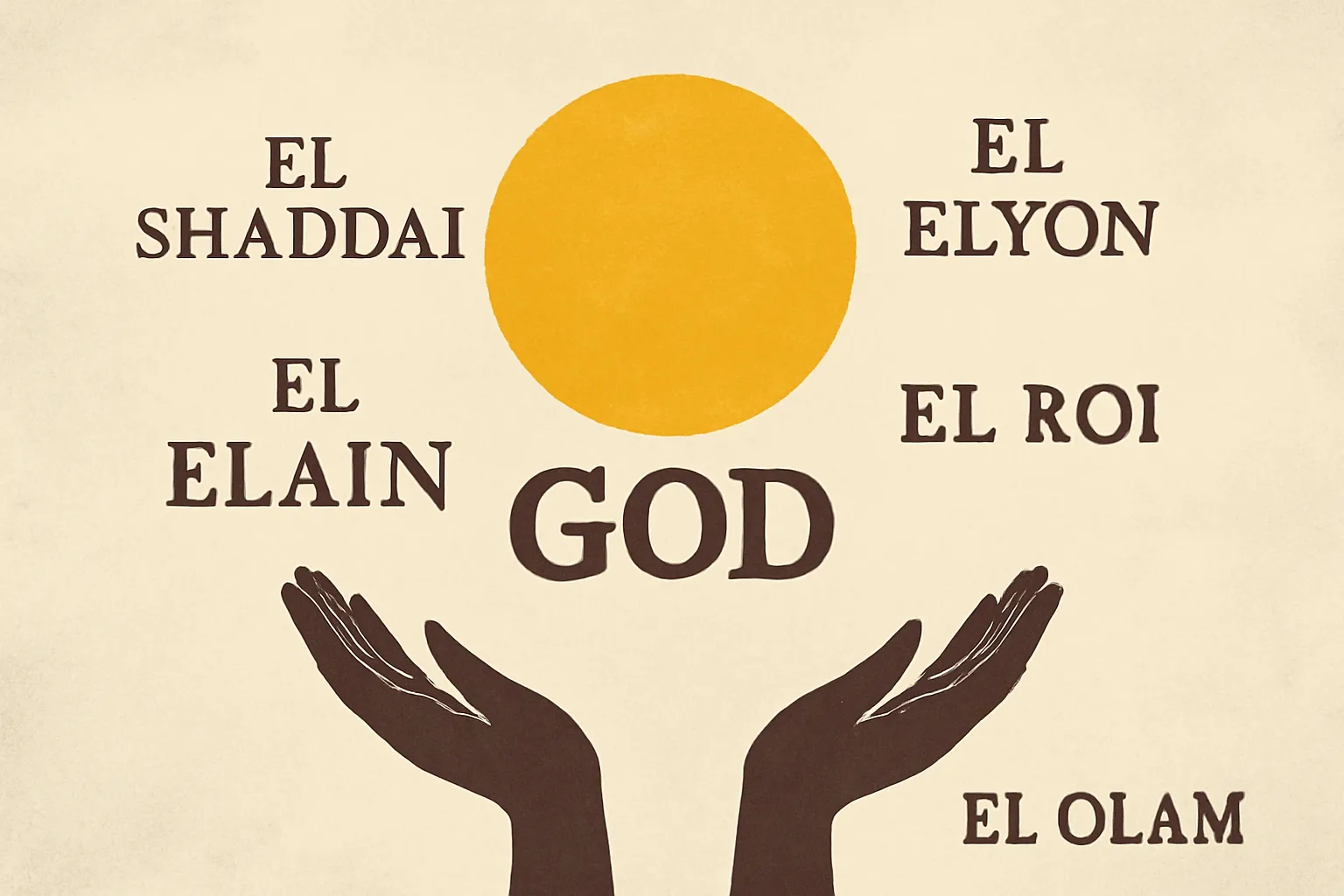
El Shaddai — usually translated as “God Almighty” or interpreted as “God of the Mountain”, highlighting power, fertility, and provision.
El Elyon — “Most High God”, emphasizing supreme sovereignty above all other powers.
El Olam — “Everlasting God”, pointing to timelessness and enduring presence beyond history.
Jehovah-Jireh — “The Lord Will Provide”, associated with provision and care in moments of need.
Jehovah-Rapha or Jehovah-Rophe — “The Lord Who Heals”, a name invoked in healing and restoration contexts.
Jehovah-Nissi — “The Lord Is My Banner”, a title of protection and victory in battle imagery.
Jehovah-Shalom — “The Lord Is Peace”, used in contexts of tranquility, reconciliation, and wholeness.
Jehovah-Tsidkenu — “The Lord Our Righteousness”, expressing the belief that God provides and embodies true righteousness.
Jehovah-Mekoddishkem (often spelled “Jehovah-Mekaddishkem”) — “The Lord Who Sanctifies You”, naming God as the source of holiness for the people.
Yah or Ya — shorter form found in some liturgical and poetic contexts, conveying intimacy and immediacy in address.
In Jewish and Christian worship, certain names are preferred in particular settings. For example, Adonai is often spoken aloud in prayer, while Yahweh is typically treated with reverent usage (often avoided in spoken speech in traditional Judaism). In many Christian contexts, Yahweh and Jehovah variants appear in hymnody, translations, and doctrinal writings, with Jehovah being common in older English translations and certain denominations. The names Elohim, El Shaddai, El Elyon, and El Olam are frequently invoked to emphasize power, sovereignty, and eternal presence.
Representative verses and devotional practices
In devotion, believers often invoke Yahweh or Adonai in prayers as a way of orienting the soul toward the divine presence.
In sacraments and psalms, titles such as El Shaddai and El Elyon appear to anchor petitions in a larger sense of cosmic order and blessing.
Names for God in Islam: the 99 Names and beyond
In Islamic theology, God is defined as Allah, the singular, sovereign Creator who has no equal. The tradition of the 99 Names (or Attributes) of God offers a rich vocabulary for prayer, reflection, and ethical living. While Arabic terms are central, many Muslims see these names as a language of divine perfection that helps believers relate to God’s various mercies, justice, and governance of the universe. The following is a representative selection of major attributes and how they are commonly understood and used in practice.
Representative names and their meanings
Allah — the One God, the proper name of God in Islam, signifying unity and uniqueness.
Ar-Rahman — the Merciful, embodying universal compassion.
Ar-Rahim — the Compassionate, often emphasizing steadfast care for the faithful.
Al-Malik — the King or sovereign ruler of all existence.
Al-Quddus — the Holy, free from any imperfection or deficiency.
As-Salam — the Source of Peace, a name inviting serenity and safety.
Al-Mu’min — the Guardian of Faith, providing trustworthy protection and security.
Al-Muhaymin — the Watcher or Protector, overseeing all creation with vigilance.
Al-Aziz — the Mightier, the indomitable power behind all strength.
Al-Jabbar — the Compeller, who sets right what is wrong and upholds justice.
Al-Mutakabbir — the Majestic, who asserts ultimate sovereignty and greatness.
Al-Khaliq — the Creator, bringing beings into existence and sustaining them.
Ar-Razzaq — the Provider, ensuring all sustenance and resources for life.
Al-Latif — the Subtle, Gentle, whose care often works in quiet, unseen ways.
Al-Ghaffar / Al-Ghafur — the Forgiver, who abundantly grants pardon and mercy.
Practical use and reverence in daily life
Muslims may recite the 99 Names in personal supplication, in communal dhikr (remembrance), or during prayer as a reminder of God’s all-encompassing attributes. The names are treated as pathways to understanding different facets of God’s character, rather than as independent deities. The diversity of names helps believers articulate needs in prayer—for mercy, justice, protection, guidance, or blessing—in a manner that reflects trust in God’s breadth and depth.
Important notes about translation and usage
The transliteration of Arabic names varies, and the same term can appear with different spellings in English. The underlying theological concept, however, remains the same: God’s attributes are perfect, comprehensive, and beyond full human comprehension. The tradition emphasizes that the 99 Names describe God’s various faces rather than limiting what God is. Names like Allah, Ar-Rahman, and Ar-Rahim are not separate entities but facets of the one divine reality.
Names for God in Hinduism and Indian traditions
Hinduism and related Indian traditions offer a vast spectrum of divine names, reflecting diverse theological schools, devotional movements, and regional languages. Unlike a single centralized monotheism, these traditions often speak of the divine in many forms—personal gods, impersonal principles, and everything in between. The categories below capture some of the most influential names and how they are used in practice.
Major names and their emphases
Ishvara (or Ishwara) — a general term for a personal divine principle or supreme lord, often translated as “Lord”.
Bhagavan — a title meaning “Blessed Lord” or “One to be revered”, used for revered incarnations and for divinity in a personal, approachable form.
Paramatma — the “Supreme Soul”, a cosmic consciousness present in all beings in some theologies.
Vishnu — the sustainer among the principal forms of the divine, often worshipped in Vaishnavism as the source of order and compassion; related forms include Narayana and Vasudeva.
Rama — an avatar of Vishnu, emblematic of righteousness and virtuous leadership; widely revered in devotional traditions and epic narratives (Ramayana).
Krishna — another avatar of Vishnu, associated with love, wisdom, and divine play; central to bhakti traditions such as Vaishnavism and the Krishna devotion lineage.
Shiva — the great yogi, creator-destroyer, and transformer’s godhead in Shaivism; often named as Shiva or Maheshvara in prayer and iconography.
Parvati (the Goddess, consort of Shiva) and other goddesses such as Durga, Kali, and Lakshmi (goddess of wealth) reflect the feminine dimension of the divine in Shaktism and broader Hindu practice.
Ganapati / Ganesha — the remover of obstacles and beloved son of Shiva and Parvati, invoked at the start of ventures and rituals.
Deva and Devi — general terms for “god” and “goddess,” used across many traditions to denote divine beings who act within the cosmos.
Paramatma — the Supreme Soul, conceptualized as a universal, immanent presence within all beings in some philosophical schools.
Shaivism: Shiva, Shankar, Maheshvara, Rudra (an early form emphasizing awe and transformative power).
Shaktism: Durga, Kali, Lakshmi, and other manifestations of the Goddess who embodies power, abundance, and protection.
Practical reflection and devotional practice
Names in this tradition are often inseparable from rituals, mantras, and iconography. Devotees may repeat names as part of japa (repetition), sing devotional songs, or contemplate them during meditation. The multiplicity of forms is sometimes harmonized through concepts such as Saguna (the Divine with attributes) and Nirguna (the Divine beyond attributes), depending on philosophical or devotional leanings. The goal is to approach the divine through accessible forms while recognizing the deeper, transcendent unity that many schools affirm.
Names of the Divine in other traditions and broader terms
Beyond specific religions, many languages and spiritual communities use general descriptors or universal titles to speak of the divine. These terms emphasize the divine’s transcendent, immanent, moral, or cosmic dimensions. The following are common categories and examples you may encounter in interfaith dialogue, comparative religion courses, or contemplative practice.
The Divine — a broad, respectful way to refer to a sacred reality beyond human constraints.
The One — emphasizes monotheistic unity and the ultimate source of all existence.
The Absolute — a term used in philosophy and spirituality to denote the self-sufficient, unconditioned ground of being.
The Source — language that highlights God as the origin of all that exists.
The Creator — a common title in monotheistic and some natural-theology contexts, focusing on origin and ongoing involvement in creation.
The Sustainer — a name that centers God’s ongoing nurture and preservation of life and order.
The Judge — evokes divine judgment, moral ordering, and accountability.
The Guide — emphasizes divine instruction, wisdom, and direction for human beings.
The All-Knowing, The All-Seeing — titles that stress omniscience and awareness of all things.
The Infinite and The Eternal — words that point to timelessness and boundless scale.
In many spiritual traditions, these generic terms accompany more specific names, providing a language for universal contemplation while respecting particular doctrinal vocabularies. They also serve as gateways for interfaith understanding, reminding readers that the impulse to name and describe the divine is widespread and deeply human.
Cross-cultural note on language and meaning
Because divine names arise in different tongues and scripts, small shifts in vowels, consonants, or syllable emphasis can carry distinct theological implications. When engaging with names across traditions, it helps to note the following:
Transliteration differences can obscure pronunciation and even nuance; two English spellings may refer to the same original term.
Names often carry liturgical or doctrinal weight that is not easily captured in a single translation.
Some names are personal and relational (God as Father, Lord, Friend), while others describe metaphysical attributes (the Infinite, the All-Powerful).
How names work in practice: from study to prayer
Names of the divine shape how people think about God and how they approach the sacred in daily life. The following practices illustrate different ways names are used in communities around the world.
Liturgy and chant: Names appear in hymns, doxologies, creeds, and congregational prayers, serving as a shared language that binds worshippers to a tradition and its history.
Personal prayer: Believers may invoke a small set of names that express their needs or gratitude, such as asking for mercy, healing, protection, or guidance.
Study and reflection: Names are explored in scriptural exegesis, poetry, and philosophy to understand how divine attributes are understood in different cultures and eras.
Art and iconography: Names are often associated with visual or symbolic representations (such as color, scent, or form) that aid memory and devotion.
Interfaith dialogue: Discussing names creates a bridge between traditions, highlighting common longings for the divine and the diversity of expression.
Readers who approach divine names with humility and curiosity can grow in both knowledge and reverence. When encountering a new name, it can be useful to ask: What attribute does this name emphasize? What relationship to God does it express? How has this name shaped the life of a community or a tradition?
Transliteration, pronunciation, and semantic breadth: navigating a world of names
The same divine name may appear in multiple languages with different spellings and pronunciations. For example, the Hebrew Yahweh may be rendered as YHWH in scholarly texts, while Christian hymnody often uses
versions such as Jehovah or Yahweh; Arabic names for God in Islam are typically transliterated as Allah, Ar-Rahman, Al-Malik, etc., with additional diacritical marks in scholarly works. The common thread is that pronunciation is shaped by linguistic tradition, but the underlying meanings endure across translations.
Some practical tips for readers exploring cross-cultural divine names:
Respect the preferred name in a given tradition; use the form most commonly employed by adherents of that tradition in public or sacred settings.
Be mindful of context: a name used in liturgy may carry different emotional weight than a name used in casual conversation.
When studying, consult multiple translations and commentaries to understand how scholars interpret a particular name’s nuance.
Engaging with names across languages can deepen one’s sense of the divine’s breadth and the human capacity to reach toward the sacred through language, ceremony, and art.
To help readers skim or reference, here is concise glossary-style recall of the main names discussed above, with emphasis on the core attribute each name expresses.
Yahweh / YHWH — God’s self-existent presence; the foundation of God’s personal, relational being.
Adonai — Lord in prayerful address, respectful substitution for the divine name.
Elohim — the Creator, sovereign power; used in a broad, inclusive sense of God’s majesty.
El Shaddai — God Almighty, source of strength and blessing.
El Elyon — Most High God, supreme sovereignty.
El Olam — Everlasting God, eternal presence.
Jehovah-Jireh — The Lord Will Provide, provision and care in need.
Jehovah-Rapha — The Lord Who Heals, restoration and mercy.
Jehovah-Nissi — The Lord Is My Banner, protection and victory.
Jehovah-Shalom — The Lord Is Peace, wholeness and reconciliation.
Jehovah-Tsidkenu — The Lord Our Righteousness, source of moral standing.
Jehovah-Mekoddishkem — The Lord Who Sanctifies You, holiness imparted by God.
Allah — Absolute One, unity of God in Islam; the proper divine name for worship and creed.
Ar-Rahman / Ar-Rahim — Merciful and Compassionate, universal mercy and particular care.
Al-Malik, Al-Quddus, As-Salam — sovereignty, holiness, and peace in God’s governance; representative attributes among many.
Ishvara / Ishwara — Lord or Supreme Controller in Hindu thought; broad, title-like reference to the divine principle.
Vishnu / Narayana / Rama / Krishna — central Vedic/Upanishadic names in Vaishnavism; savior and sustainer aspects of the divine.
Shiva / Maheshvara — the cosmic transformer, unity of destruction and renewal in Shaivism.
Deva / Devi — generic terms for god/goddess across many Indian traditions.
Ganapati / Ganesha — remover of obstacles, auspicious start of endeavor.
Concluding reflection: embracing breadth with discernment
Names for God serve as doors rather than walls—doors to encounter, tune the heart toward the divine, and connect with communities across time and space. A complete guide to divine names invites readers to honor the particular beliefs of others while recognizing a shared impulse: to name the unspeakable with care, to articulate wonder, and to seek wisdom, mercy, and justice from the source of all being. Whether one speaks of Yahweh, Allah, Vishnu, Shiva, or The Divine itself, the core purpose remains: to cultivate reverence, understand moral meaning, and nurture relationship with the sacred in all its radiant diversity.
As you continue your own exploration, consider keeping a small glossary or notebook of names you encounter, noting the tradition, the primary attribute, and the context in which it appears. Over time, you may discover a personal connective thread—an anchor in prayer, study, or service—that links together many names into a living, dynamic practice of faith and reflection.