Short Story About the Birth of Jesus: A Heartfelt Nativity Tale
In this extended short story, we explore the tender moments, the quiet courage, and the luminous signs surrounding the birth of Jesus. Told as a thoughtful narrative that blends reverent memory with human detail, the tale invites readers to walk through the streets of Nazareth and the lanes of Bethlehem, to listen to the whispers of angels, and to feel the warmth of a humble stable where a newborn light began to glow. This is a heartfelt Nativity tale that speaks to generations, offering both a story and a mirror: a story about the birth of Jesus told from multiple viewpoints, and a mirror in which readers may see the universal themes of hope, humility, and companionship reflected in their own lives.
Setting the Scene: Nazareth, Bethlehem, and the Long Wait
To begin a short story about the birth of Jesus, it helps to set the scene with a sense of place and time. In the first chapters of the tale, we travel to Nazareth, a quiet village where a young woman named Mary lives, and we follow the quiet strength of a carpenter named Joseph. The air is earthy, the days are simple, and the people are busy with the ordinary tasks of farming, family, and worship. Yet beneath the ordinary, a more extraordinary plan unfolds. The narrative invites readers to notice the small details: the smell of clay in the workshop, the sound of shepherds in the distance, and the way the evening stars begin to glimmer earlier than usual as if to announce something new.
In the broader arc of this narrative about Jesus, the journey from Nazareth to Bethlehem becomes a central thread. The census decreed by the Roman government disrupts normal life and prompts Mary and Joseph to travel, not as royals but as ordinary travelers who must rely on one another and on the hospitality of those they meet along the road. The story uses these scenes to emphasize a timeless truth: the birth of a savior often arrives where we least expect it, carried on the shoulders of a community that gathers to support a family in need. The Bethlehem night is a key turning point in the tale, where the heavens seem closer and the world seems suddenly narrower, as if the cosmos itself is leaning in to witness a miracle.
A Bethlehem Night: The Journey and the Quiet Miracle
Mary’s Perspective: Quiet Courage and Hope
From Mary’s point of view, the narrative unfolds as a series of intimate moments that reveal her resilience and her deep faith. She is not merely a vessel for a divine plan; she is a person who asks questions, feels fear, and chooses to trust. The short tale about the birth of Jesus from her perspective invites readers to consider the difficult choices she makes, and the way she accepts a future that is larger than her own expectations. Her courage is not loud; it is a steady, patient endurance that lights the way for others who might doubt or worry. She reflects on the words spoken by the angel, on the weight of responsibility, and on the sacredness of the life growing within her. In her mind and heart, the incarnation feels personal, yet universally relevant—an event that redefines what it means to belong and what it means to carry hope into a world that often feels uncertain.
Joseph’s Resolve: Humility in Action
Joseph’s role in the tale is equally essential. The construction of a safe, dignified space for Mary and the child is a testament to humility in action. He listens, he plans, he acts with practical prudence, and yet he remains open to the extraordinary that unfolds around him. The story about the birth of Jesus gains emotional depth when seen through Joseph’s eyes: a craftsman who steadies the ship of his family, who chooses to trust in the divine message even when it defies ordinary expectations, and who offers steady shelter and protection in the hours when fear and doubt threaten to overwhelm. His quiet bravery becomes a template for readers who understand that leadership often looks like service, and that courage can be gentle, steadfast, and daily.
The Angelic Messenger: Gabriel’s Visit and the Sign of Wonder
The Visit to Mary: A Message of Promise
The moment of Gabriel’s appearance to Mary is a cornerstone of the Nativity tale. The angel’s words—announcing that Mary will bear a child and that the child will be called the Son of the Most High—invite a response tempered by wonder. The narrative uses this visitation to underscore the power of faith under pressure: to be chosen for a task beyond one’s previous imagining is both a privilege and a responsibility. The dialogue between Mary and the angel becomes a conversation about trust, obedience, and the way one person’s yes can ripple outward into a world of[bold] new possibilities.
The Angelic Chorus and the Sign: A Sky Full of Hope
Beyond Mary’s private moment, the short story widens to the cosmic sign that accompanies this turning point. Angels appear to shepherds, and a chorus fills the night with a message of peace: «Glory to God in the highest, and on earth peace, good will toward men.» This declaration anchors the narrative in a broader sense of purpose, reminding readers that the birth of Jesus is not only a personal event for Mary and Joseph but a global moment that invites all people to consider the presence of the divine in the ordinary. The narrative uses the sign—the light, the song, the sense of awe—as an accessible symbol for readers of all ages to grasp the magnitude of what is unfolding.
The Long Road to Bethlehem: Travel, Shelter, and the Birth in a Stable
The Humble Journey: A Family in Motion
The journey to Bethlehem is more than a geography lesson; it is a test of endurance and faith. The road is not smooth, and the couple must navigate delays, crowded inns, and the sense that time is pressing forward with a rhythm that cannot be slowed. Yet in the challenges there is a kind of rhythm too—the rhythm of patience, of relying on one another, of keeping faith alive when circumstances press hard against it. This is a core tone in the short story about Christ’s birth: a reminder that even in the most difficult chapters, love and perseverance illuminate the path forward.
The Stable, the Manger, and the Animals: A Scene of Quiet Reverence
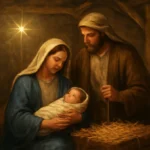
When Mary and Joseph finally find shelter, the scene of the birth itself offers a powerful symbol. The stable becomes a sanctuary, and the manger becomes a cradle for hope. The animals gather in the soft light, and the lowing of cattle and the aroma of hay create a sensory frame for the miracle to emerge. The birth does not happen in a palace; it happens in a place that invites humility, simplicity, and openness to grace. This contrast—between grand expectation and humble reality—forms a central tension in the tale and invites readers to consider how the extraordinary often arrives through the most ordinary of doors.
A Nativity Evening: The Birth of Jesus and the First Witnesses
The Shepherds: Night Watchers and Messengers of Wonder
The shepherds in the story, ordinary laborers who keep watch over their flocks at night, become the first witnesses to the newborn king. The narrative gives them a voice, placing their awe at the center of the scene. Their encounter with the angels, their hurried journey to the stable, and their response of worship demonstrate a pattern that resonates through generations: when the divine intersects with daily life, humble observers become the first to testify to a profound truth. The short tale about Jesus’ birth thus expands beyond a single moment to become a shared event, a memory that collects the village’s breath and holds it in the heart of the night.
The Magi and the Dawn of a New Learning
In some versions of the story, the visiting Magi add a later note to the Nativity, bringing gifts and bearing witness to a universality of meaning. They travel not from nearby fields but from distant lands, guided by a star that functions as a compass toward a new dawn. The inclusion of the Magi in certain tellings broadens the semantic reach of the tale, turning it into a narrative about not only a birth, but a revelation that travels across cultures and continents. In a well-rounded short narrative about the birth of Jesus, their actions illuminate how a single event can spark curiosity, exchange, and a longing to learn more about what it means for people in many places to meet the same source of light.
Significant Moments and Meanings: Keys to the Heart of the Tale
Humility as a strength: the birth takes place in a humble setting, reminding readers that greatness often enters through modest doors.
Hope in the darkness: the night sky becomes a canvas for a message of hope that transcends fear.
Divine presence in ordinary life: the narrative invites readers to look for moments when the sacred touches the everyday.
Community support: Mary and Joseph are surrounded by neighbors, angels, shepherds, and later visitors who contribute to the sense that a newborn brings a shared responsibility for care and protection.
Light in the manger: the manger itself becomes a symbol of light entering the world in a place of vulnerability.
This section of the article emphasizes how recurring motifs in the Nativity story can be read as moral and spiritual guidance. The birth of Jesus is framed not only as a historical or religious event but as a metaphor for transformation that begins with small acts of faith and kindness—acts that, taken together, can illuminate entire communities.
Variations of the Short Story About the Birth of Jesus
To broaden semantic breadth and invite readers to see the same sacred moment from different angles, this section offers several variations of the short story about the birth of Jesus, each told with a distinct emphasis or perspective. These variants demonstrate the flexibility of the Nativity narrative and its capacity to speak to diverse audiences and contexts.
Variation A: Brief Tale of the Nativity from a Village Child’s Voice
In this version, a child from the village discovers a new star in the night sky and rushes to tell the elders. The story is told in concise, simple lines that emphasize wonder, curiosity, and a child’s sense of awe. The core events—Mary, Joseph, the journey, the stable, the newborn baby—are present, but the language is pared down to reflect a child’s viewpoint. The result is a brief tale of the Nativity that feels intimate and immediate, inviting families to share a moment of storytelling around a dinner table or by a fire.
Variation B: A Shepherd’s Journal Entry
Another variation invites readers to see the Nativity through the eyes of a shepherd who records the events in a rough, work-worn journal. The tone is earthy and practical, yet soft with reverence when the angels appear and when the baby’s sighs fill the night. The shepherd’s notes turn the Nativity into a human timeline—a sequence of ordinary duties that culminates in a revelation about divine companionship and responsibility. This narrative of Jesus’ birth acknowledges how faith can take root in daily labor and how a single night can alter a lifetime of work and belief.
Variation C: A Traveler’s Perspective from a Nearby Innkeeper
In this spin, an innkeeper who briefly encounters Mary and Joseph describes the crowded streets and the moment when the doors close to a weary family seeking shelter. The innkeeper’s reflections weave hospitality, mercy, and fear into a nuanced understanding of what it means to welcome or turn away. When the baby arrives in a cave-like space beyond the inn, the innkeeper’s heart shifts toward generosity and grace, revealing how the Nativity story can be a lesson in leadership and mercy for communities facing crisis or shortage. This version invites readers to consider the ripple effect of kindness as a small act that can echo through generations.
Variation D: A Wise Man’s Computational Interpretation
In a more imaginative approach, a wise figure from distant lands interprets the star and interprets the signs through symbol, poetry, and a sense of cosmic timing. This variant emphasizes curiosity, interfaith dialogue, and the universality of seeking truth. The wise person’s notes turn a sacred moment into a cross-cultural exchange of ideas, illustrating how the birth of Jesus can be a bridge between civilizations, a reminder that the light of one birth has the potential to illuminate many paths.
For Readers and Learners: How to Engage with a Nativity Tale
As an educational piece, this article invites readers to engage with the birth of Jesus not only as a devotional moment but as a text that can be analyzed, discussed, and interpreted from multiple angles. Here are some ways to deepen understanding and appreciation:
Compare the biblical accounts in Luke and Matthew with the homiletic or artistic retellings that appear in literature, music, and film. Notice what details are emphasized in each version and how that shapes meaning.
Explore the symbolism of light, stars, and the manger. Consider how these images function as metaphors for hope, guidance, and vulnerability.
Discuss the themes of hospitality and inclusion. How do different characters extend welcome, and what does that reveal about the values of the story?
Analyze the voice and perspective of the narrative. How does shifting the point of view—from Mary to Joseph to a shepherd—alter the emotional impact?
Reflect on the modern relevance of the Nativity. In what ways can a heartfelt Nativity tale inform contemporary discussions about family, poverty, migration, and care for the vulnerable?
Educators might use these variations to prompt writing exercises, creative retellings, or critical discussions. Students could be asked to rewrite the scene from a different cultural lens, or to compose a short poem that captures a single moment from the story’s atmosphere. The Nativity, after all, is not just a single event—it is a constellation of moments that invite ongoing reflection and dialogue.
Teaching Points: Historical Context, Language, and Cross-Cultural Retellings
In a thorough examination of the birth narrative, it is helpful to introduce some historical context. The setting likely reflects a combination of historical Bethlehem in the era of Roman rule and the cultural traditions of first-century Jewish communities in Galilee and Judea. The language of the tale borrows from biblical idioms while also inviting modern readers through accessible, vivid imagery. The use of a humble stable rather than a grand palace highlights humility as a moral arc, a theme that resonates across faith traditions and cultural retellings.
Cross-cultural retellings often place the Nativity in different artistic styles—iconography, music, theater, and film—that emphasize varied aspects of the story. Some versions foreground the shepherds’ perspective, others focus on the Magi’s journey across deserts and seas, while still others emphasize the universal message of peace and goodwill toward all people. Each retelling preserves core elements—the birth in Bethlehem, the presence of Mary and Joseph, the sign of the angels—while expanding the ways in which readers experience the story. This breadth of interpretation is part of what makes the short story about the birth of Jesus so enduring and adaptable across generations.
Closing Reflections: The Enduring Light of the Nativity
Returning to the core moments of this heartfelt Nativity tale, readers are invited to carry the imagery of the night sky, the warmth of the stable, and the gentle wonder of a newborn child into their daily lives. The story does not demand a single conclusion; instead, it offers a space for contemplation, remembrance, and renewed purpose. The birth of Jesus, as presented in these pages, is a beacon that invites people to be kinder, more patient, and more generous—to extend hospitality to strangers, to protect the vulnerable, and to nurture hope even when circumstances are challenging. By approaching the Nativity with curiosity about its varied tellings, readers gain a richer sense of how a single, life-affirming event can echo through time, shaping faith, art, and neighborly love in countless ways.
In this way, the short story about the birth of Jesus becomes not only a narrative about a sacred birth but also a living invitation: to listen, to witness, and to respond with grace in a world that often longs for light. The tale, in its many layers and perspectives, remains a testament to resilience, community, and the quiet power of a newborn’s cry to awaken hearts and to kindle a shared sense of wonder. It is, at its heart, a timeless narrative about beginnings, about the sacred meeting the everyday, and about a little light that has continued to illuminate countless lives across centuries and cultures.