Did Jesus Talk About Tithing? An Overview in Biblical Context
The question “Did Jesus talk about tithing?” sits at the intersection of
Old Testament law, New Testament grace, and the broader pattern of biblical
teaching about money, generosity, and justice. Tithing—the practice of giving a tenth of one’s
income or produce to support religious leaders and the community—has deep roots in the
Hebrew Bible. In the Gospels, however, Jesus speaks in ways that illuminate how
his followers should think about money, possessions, and giving. He does not simply rehearse a
law-based obligation; he calls for a deeper, wholehearted devotion that includes justice, mercy,
and faithfulness. This article surveys key passages, their literary and theological context, and
how Jesus’ examples have been interpreted in Christian tradition.
Tithing in the Hebrew Bible: What the Practice Was About
Before examining Jesus’ words, it helps to situate tithing in its historical and
religious setting. In the Hebrew Bible, tithes functioned within a system designed to
sustain the Levitical priesthood, support the temple, assist the poor, and affirm worship.
The tithe as law: The practice was commanded in passages such as Leviticus, Numbers,
and Deuteronomy, requiring the Israelites to set aside a tenth of agricultural produce or
income for the Levites, the priests, and special temple-related purposes.
Multiple tithes: Some biblical laws mandated various tithes at different times (for
the Levites, for festival meals, and for the poor), creating a complex framework of giving that
went beyond a single ten percent figure.
Ethical aims: Tithing was not only a financial transfer; it was a lived practice tied to
worship, covenant faithfulness, and social justice. The prophets repeatedly warned that
ritual giving without justice and mercy was hollow.
In short, tithing in the Old Testament was a structured, covenantal practice designed to
sustain communal worship and ensure care for the vulnerable. It carried moral and theological weight
within the life of Israel.
Jesus and the Law: How the Gospels Speak to Tithing
Jesus both upholds and critiques aspects of the Mosaic Law as it touches
money and righteousness. The Gospels record his statements about money, possessions, and
generosity in ways that invite readers to read tithing in a broader ethical light. The
key is not merely whether Jesus affirmed a fixed percentage of one’s income, but whether
one’s heart and actions reflect justice, mercy, and faithfulness alongside any formal giving.
There are moments in the Gospels where Jesus affirms the importance of righteousness alongside
the act of giving, and there are explicit rebukes of religious leaders who outwardly observe
certain practices while neglecting weightier matters. In this sense, the question “Did Jesus speak about tithing?” becomes a question about the place of money in discipleship:
how to give, to whom, and with what attitude?
Across the Gospel narratives, three themes recur:
Affirmation with critique: Jesus often acknowledges the value of righteous actions (including
giving) while warning against hypocrisy and legalism.
Prioritizing justice, mercy, and faithfulness: In passages where tithing is mentioned or implied,
the broader demands of justice and compassion are highlighted as the more important matters.
Humility in giving: Jesus’ teaching and example invite believers to give with humility rather than
as a display of piety or social status.
With this framework in mind, we can examine the explicit passages that touch on tithing and related
practices, and consider how they fit within Jesus’ larger message.
Key Passages Where Jesus Talks About Tithing
Matthew 23:23 — A Critical Balance Between Tithing and Justice
In this passage, Jesus directs a sharp rebuke at religious leaders who are meticulous about tithing even down to tiny garden herbs—mint, dill, cumin—while neglecting the weightier matters of the
law: justice, mercy, and faithfulness.
“Woe to you, scribes and Pharisees, hypocrites! For you tithe mint and dill and cumin, and have neglected
the weightier matters of the law: justice and mercy and faithfulness. These you ought to have done,
without neglecting the others.”
The emphasis here is not a blanket condemnation of all tithing but a rebuke of legalistic
piety that neglects the heart of the law. Jesus suggests that the practice of giving must be
integrated with ethical conduct. Genuine righteousness cannot be reduced to outward
displays of meticulous rule-keeping. The passage is often cited to illustrate that giving in the kingdom of God must flow from a heart transformed by justice and mercy.
Luke’s Gospel contains a parallel saying that echoes Matthew 23:23, addressing the same
tension between meticulous tithing and the broader will of God.
“But woe to you Pharisees! For you tithe mint and rue and all kinds of herbs, and you bypass justice and the love of God.”
The rhythm of Luke 11:42 mirrors Matthew 23:23: external acts of giving are not enough if justice, mercy, and the love of God are neglected. The Gospel writer foregrounds the
ethical dimension of giving, underscoring that generosity must be rooted in
a right relationship with God and others.
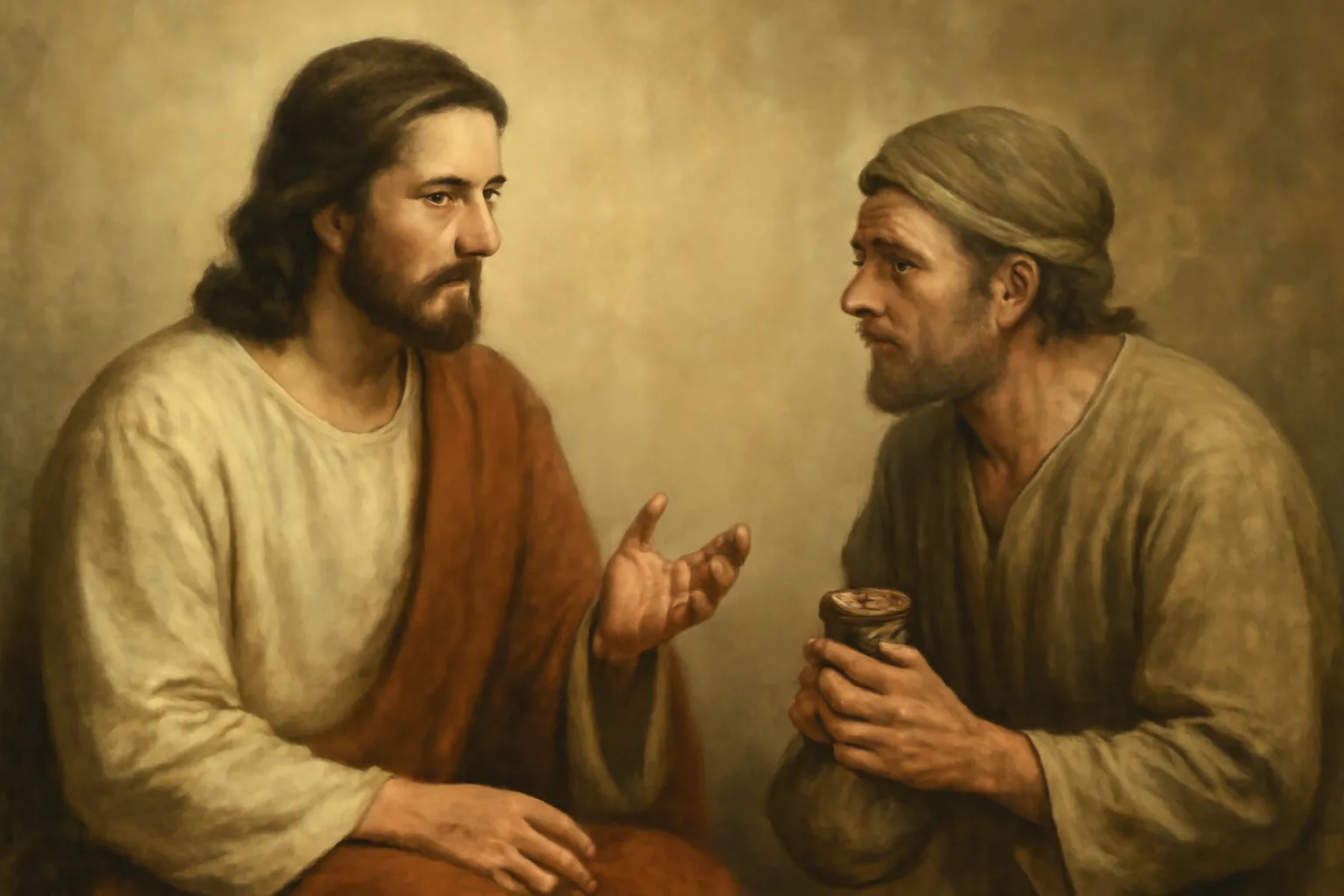
Luke 18:9-14 — The Pharisee, the Tax Collector, and the Question of Tithing
This well-known parable does not center on tithing as a formal practice but engages with the
posture of the giver. The Pharisee’s prayer boasts of his righteousness, including his
adherence to religious disciplines and his tithing, while the tax collector humbly asks for mercy.
“The Pharisee stood by himself and prayed: ‘I thank you that I am not like other people—robbers, evildoers,
adulterers—or even like this tax collector. I fast twice a week and give tithes of all I possess.’”
The point of the parable is not to condemn tithing per se, but to challenge readers to consider
the condition of the heart behind giving. The tax collector, who acknowledges sin and needs mercy,
is justified, while the self-assured Pharisee, who touts his own righteousness, is not. In this sense,
the passage can be read as a critique of self-righteous legalism, including when tithing becomes a badge
of moral superiority rather than a humble response to God’s grace.
Mark 12:41-44 / Luke 21:1-4 — The Widow’s Offering and the Value of Generosity
The story of the widow who gives two small coins illustrates a different facet of giving that Jesus
elevates. The poor widow’s contribution is not measured by the amount but by the trust and sacrifice
behind it. Jesus comments on the contrast between the conspicuous generosity of some donors and the quiet,
faithful giving of one who has little but gives all she has.
“Truly I tell you, this poor widow has put more into the offering box than all the others. They all gave out of their
wealth; but she, out of her poverty, put in everything—all she had to live on.”
This narrative highlights a broader biblical principle: genuine generosity is not about the exact
percentage or legal requirement, but about the heart’s trust in God and willingness to give in a way that
reflects dependence on God rather than on wealth. While tithing is a historical practice in the Mosaic Law,
the widow’s mite invites readers to consider how everyday giving, sacrifice, and trust in God function within
the New Covenant.
Related New Testament Teachings on Money and Giving
Although the explicit term “tithing” appears more in the Gospels in the context of Jesus
addressing Pharisees, the New Testament as a whole expands the conversation to include
generosity as a regular and joyful response to God’s grace. While Jesus does not always
rearticulate the Mosaic tithe as a universal mandate for all believers, his
teaching consistently invites his followers to give with humility, compassion, and trust.
Luke 6:38 — “Give, and it will be given to you.” A principle that generosity opens
channels of blessing, emphasizing the reciprocity of giving within God’s kingdom.
Acts 2:44-45 and Acts 4:32-37 — Early Christian communities sharing possessions
to meet each other’s needs, showing a communal mindset that extends generosity beyond a fixed percentage.
2 Corinthians 9:6-7 — “Each one must give as he has decided in his heart, not reluctantly or under
compulsion, for God loves a cheerful giver.” While not Jesus’ own words, this teaching reflects the
New Testament ethic of cheerful, voluntary giving that flows from gratitude.
These passages illustrate that, for the earliest followers of Jesus, the heart attitude and
communal care accompanying giving matter as much as any formal requirement. The spirit of generosity is celebrated, and wealth is considered a resource to be used
for the good of others and the advancement of the gospel.
How Should We Read These Passages Today?
Interpreting Jesus’ comments about tithing requires careful attention to both the historical context and
the overarching theological themes of the New Testament. Several guiding considerations help readers
apply these passages today:
Context matters: In Jesus’ day, tithing was part of a covenantal system tied to
the temple and priesthood. Jesus’ challenge is often to expose hypocrisy and to call for
wholehearted devotion to God that aligns with justice and mercy.
Heart over habit: The key concern is the condition of the heart behind giving. Does giving reflect
love for neighbor, trust in God, and willingness to sacrifice for the vulnerable?
Purpose of generosity: The biblical pattern emphasizes that money and possessions are tools for
serving God’s reign, not a mark of righteousness in themselves. The real measure is how generosity
advances justice, mercy, and the well-being of others.
Ethical living: The weightier matters—justice, mercy, faithfulness—are central to Jesus’
critique of religious life. Any practice of giving must be integrated with ethical actions that
reflect the character of God.
In reading Did Jesus talk about tithing? or Did Jesus address tithing?, the
balanced answer is: Jesus engages with money, wealth, and giving, confirming
that generosity is part of discipleship, while at the same time challenging
legalism that uses the letter of the law to mask a lack of mercy and justice.
The best approach is to read these passages as a composite picture of
how gifts to God should be offered—humbly, joyfully, and in ways that
align with God’s desire to bless the vulnerable and the marginalized.
Tithing as a starting point: Some Christians view tithing (ten percent) as a meaningful starting point for
budgeting how they support the church and its ministries. Others see it as an ancient command that is
superseded by the New Covenant’s call to cheerful, voluntary giving. The biblical pattern invites
discernment and prayer in deciding how to give.
Giving with the right attitude: The stories of the widow and of the Pharisee
underscore the importance of generosity that flows from gratitude and dependence on God, not from
pride or ritual performance.
Let giving reflect justice and mercy: Jesus’ critique of those who tithe while neglecting justice
and mercy suggests that financial generosity should be paired with acts of social righteousness—caring
for the poor, pursuing fairness, and showing mercy to others.
Flexibility in spiritual growth: Different Christian traditions emphasize different practices—some
emphasize fixed percentage giving to the church, others emphasize freegiving as the Spirit leads. The
core is to cultivate a generous, faithful life that honors God and serves the common good.
Whether one uses the language of tithing, freewill offering, or cheerful giving, the aim remains
to express devotion to God through generosity that blesses others. The voice of Jesus in the Gospel
accounts invites believers to examine not only what they give, but why and how they give, and to
ensure that money serves the broader purposes of justice, mercy, and the flourishing of the community.
Summary: Did Jesus Talk About Tithing?
The succinct answer is nuanced. Jesus does address giving and interacts with the practice of tithing,
but he does so within a larger critique of legalism and a call to genuine righteousness. In Matthew 23:23
and Luke 11:42, he condemns a form of tithing that neglects other divine priorities. In Luke 18:9-14, the
focus shifts to humility and a right heart rather than the outward tally of one’s offerings. In the
widow’s offering (Mark 12:41-44; Luke 21:1-4), Jesus elevates generosity that rests on trust in God, even
when the gift is small in human eyes. Taken together, these passages show that Jesus spoke about money and
giving in a way that emphasizes integrity, mercy, and an orientation toward God’s kingdom over ritual
display.
For readers today, the takeaway is not simply a rule about how much to give, but a call to
live generously in a way that reflects God’s justice and compassion. The tradition that follows
Jesus inherits the impulse toward generosity, while also inviting reflection on the best expression
of giving in different cultural and economic contexts.