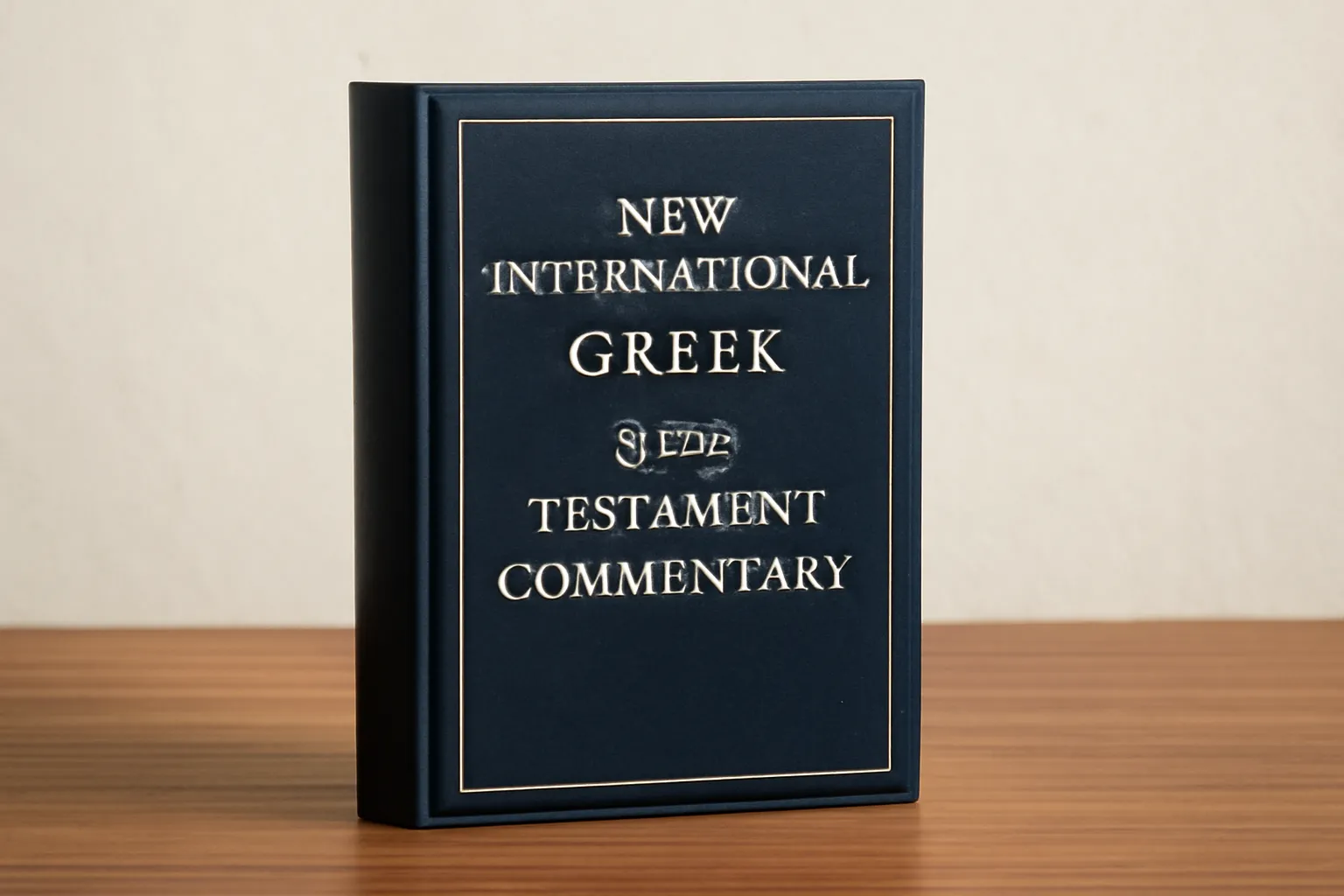
Introduction to the New International Greek Testament Commentary
The study of the New Testament benefits from carefully crafted reference works that bridge linguistic,
historical, and theological inquiry. Among the most influential systems in this field are the New International Greek Testament Commentary series and its English-language counterpart
families. While the phrase New International Greek New Testament Commentary appears in informal usage,
the established titles readers typically encounter are the New International Commentary on the New Testament
(NICNT) and the New International Greek Testament Commentary (NIGTC).
In this guide, we will treat the NICNT as the English-language anthology in the broader family
of scholarly commentaries, and we will treat the NIGTC as the Greek-focused companion that emphasizes
detailed exegesis rooted in the Greek text. We will also reference how readers sometimes encounter the phrase New International Greek Testament Commentary as a shorthand or mix-up, and we will provide clear
distinctions so students can navigate effectively.
What is the New International Greek Testament Commentary (NIGTC) and why it matters?
The NIGTC is a prestigious scholarly series designed to support serious Bible study by presenting
careful exegesis of each book of the New Testament in light of the Greek text. Each volume typically offers:
Introductory material that surveys authorship, date, audience, purpose, and historical context.
Textual notes that engage with the Greek manuscripts, textual variants, and critical apparatus.
Lexical and grammatical analysis that explains nuanced Greek words and syntactic structures.
Exegetical commentary arranged per pericope or pericopae, with attention to discourse, form, and function.
Theological and practical implications that connect interpretation to faith, doctrine, and pastoral application.
Bibliography and resources for further study, including primary Greek texts, monographs, and articles.
Because the NIGTC is deeply grounded in the Greek text, it can be especially valuable for students who want
to examine the original language, evaluate textual variants, and understand how those details influence translation and
interpretation. This Greek-centric approach complements the broader NICNT’s emphasis on historical background and theological
significance, providing a cohesive pair of tools for serious study.
Overview of the structure and aims of a typical NIGTC volume
A standard volume in the New International Greek Testament Commentary line is crafted to be both
comprehensive and usable. The editors aim to present a balanced synthesis of critical scholarship and accessible
exposition that pastors, advanced students, and lay readers can apply in a meaningful way.
Key components you will encounter
Introduction with background on authorship, date, historical setting, and purpose of the book.
Textual apparatus and notes that discuss textual variants and the reliability of the Greek manuscript tradition.
Greek linguistic notes that explain idioms, grammar, tense, mood, and aspect as they relate to interpretation.
Verse-by-verse or pericope-by-pericope commentary that engages with the original language and context.
Explanatory notes focusing on unusual vocabulary, technical terms, and their implications for translation.
Theological implications that connect the narrative or argument to broader biblical theology.
Cross-references to other scriptural passages and to parallel fields such as patristic writings or recent scholarship.
Literature cited and a curated bibliography to guide further study.
In practice, readers often find that the NIGTC provides a robust toolkit for delving into the Greek
text, while also helping readers understand how those Greek details shape interpretation of key passages, sermons, and
academic papers. The series is deliberately rigorous, but each volume also seeks to be a usable reference for those who
want to engage deeply with the text.
Historical development and editorial approach
The New International Greek Testament Commentary project grew out of a tradition that valued
meticulous exegesis anchored in the Greek language and scholarly dialogue. While contemporary readers may encounter
several commentaries across various publishers, the NIGTC has often distinguished itself by:
Encouraging readers to examine how textual variants affect interpretation and translation.
Integrating insights from grammatical and syntactic study with theological reflection.
Providing a clear scholarly apparatus that situates the interpretation in a broad field of scholarship.
The editors and contributors of the New International Greek Testament Commentary series typically include
scholars who specialize in the Greek text, early Christian contexts, and New Testament theology. The result is a body of work
that can be used in university seminars, seminary classrooms, sermon preparation, and private study.
How the NICNT and NIGTC complement each other for Bible study
While the New International Commentary on the New Testament (NICNT) emphasizes a broader historical-
theological reading of each book, the New International Greek Testament Commentary (NIGTC) zooms in on
the Greek text with rigorous philology and textual criticism. Readers who use both series can achieve a fuller
understanding:
NICNT provides cultural, historical, and canonical context that helps readers grasp how a book’s message was
heard in its original setting.
NIGTC supplies precise language study, Greek grammar, and textual considerations that affect meaning and
translation.
Together, they offer a two-dimensional view of a New Testament book: the historical-theological frame
and the linguistic-technical frame.
For students of biblical languages, this combination is particularly powerful. You can read a pericope in the NICNT to
understand the author’s purpose and audience, then consult the NIGTC to dissect how the Greek text shapes that larger
interpretation. This combined approach can illuminate translation decisions, such as decisions about word choice, tense
and aspect, and the significance of particular syntactic structures.
Using the New International Greek Testament Commentary for study today
The practical use of the NIGTC in contemporary study depends on your goals, proficiency with Greek,
and the level of technical detail you are prepared to explore. Here are several productive ways to incorporate the series
into your routine.
For graduate-level or advanced undergraduate study
Read the introduction to gain a strong sense of authorship, date, and context before diving into the text.
Engage with the textual notes to understand critical variants and their possible impact on rendering the passage.
Study the grammatical sections to refine your grasp of Greek syntax and how it informs meaning.
Consult the bibliography to locate primary sources and scholarly debates that can support a research project.
For seminary students and pastors preparing sermons
Use the pericope-by-pericope commentary to craft sound exegesis notes that address the original language and audience.
Pay attention to theological implications to avoid misrepresenting doctrinal themes in preaching.
Cross-check key terms with a lexicon or an interlinear resource to ensure precise word choice in translation.
For lay readers seeking depth without extensive Greek study
Read the clear explanations of main issues, while using English translations as a bridge to the Greek notes.
Use the cross-references to see how a passage interacts with the broader New Testament witness.
Focus on practical implications and how the text speaks to present-day faith and practice.
Glossary of terms you will encounter in the NIGTC
As you work with the New International Greek Testament Commentary volumes, you will meet a set of terms
that are common in scholarly exegesis. Becoming familiar with these terms will help you read more efficiently.
Textual criticism – analysis of manuscript evidence to determine the most likely original wording.
Textual variants – differences among manuscripts that may affect interpretation.
Lexical note – discussion of a specific Greek word’s meaning, range, and nuance.
Grammatical and syntactic analysis – examination of how verbs, nouns, and clauses function together.
Pericope – a self-contained passage or narrative designed for analysis in the commentary format.
Discourse structure – understanding of how larger sections are organized and how argument or narrative unfolds.
Semantic range – the spectrum of possible meanings for a word within a given context.
While this glossary is not exhaustive, becoming comfortable with these terms will help you navigate the NIGTC and related
scholarly works with greater ease.
How to approach a reading plan using the New International Greek Testament Commentary
A thoughtful reading plan can maximize the benefits of the New International Greek Testament Commentary when
you are studying the New Testament. Here is a suggested sequence that balances language, context, and application.
Select a book and skim the introduction to understand the author, audience, purpose, and date.
Read the overview of the book’s main themes to orient your study.
Choose a pericope (a passage or section) to study in depth and consult the corresponding NIGTC notes.
Examine the Greek notes for the selected pericope, focusing on key verbs, participles, and syntactic constructions.
Compare translations with the Greek and with English renderings to observe where language choices diverge.
Assess textual variants that may influence interpretation and reflect on their potential impact on translation choices.
Reflect on theology and practice by connecting the passage’s meaning to broader biblical themes and contemporary life.
Tips for sustained engagement
Keep a reading journal for notes on linguistic insights and theological reflections.
Use a textual apparatus to identify where variants exist and why editors weigh certain readings more highly.
Integrate secondary sources cautiously, balancing scholarly arguments with your own reading of the text.
Common questions about the scope and accessibility of the NICNT/NIGTC family
Readers often ask about how best to access these volumes, whether in print or digital formats, and how to
prioritize volumes for study. Here are answers to some frequently asked questions.
Are these volumes suitable for beginners? They are typically targeted at readers with some background in biblical studies
or Greek. Beginners can still benefit, but it may require supplemental resources such as grammar primers or glossaries.
Should I prefer print or digital editions? Digital editions offer searchability, cross-references, and easier access to large corpora.
Print editions, however, often provide a tactile reading experience and may be preferred in classroom settings.
How do the two series relate to one another? The NICNT and the NIGTC complement each other. NICNT emphasizes historical context and theological synthesis, while NIGTC emphasizes the Greek text, philology, and textual criticism.
Can these commentaries be used for sermon preparation? Yes, but with discernment. Use the linguistic and textual insights to inform translation choices and to shape careful, faithful interpretation.
In today’s library and digital environments, readers have multiple pathways to access the New International Greek
Testament Commentary materials. Options typically include:
Publisher websites offering purchase or institutional access to volumes.
Academic databases that provide e-books or integrated notes for students and faculty.
University libraries that maintain print and digital copies for student use.
Open-access supplements or companion resources provided by seminaries or study groups (where available).
For educators and researchers, the digital formats often feature advanced search capabilities, cross-referencing with other
scholarly tools, and the ability to annotate and share notes with classmates or congregation members.
Choosing between the NICNT and the NIGTC for your study goals
When readers plan a long-term study program, choosing between these two lines often comes down to goals and language
proficiency.
Choose NICNT if your aim is to develop a broad, theologically oriented understanding of a book within its canonical
and historical context. This path is especially useful for pastors, theologians, and students seeking a synthesis of
interpretation and application.
Choose NIGTC if your aim is to engage deeply with the Greek text, grapple with textual criticism, and explore
precise linguistic interpretation. This path is particularly valuable for students of Greek, textual criticism, and advanced
exegetical work.
It is common for diligent readers to consult both lines. The combined use of NICNT and NIGTC can yield a richer, more
nuanced understanding than relying on a single source, especially for complex passages where textual decisions influence
theological meaning.
Sample reading plan: a semester-long approach to a New Testament book
To illustrate how one might structure study using the New International Greek Testament Commentary line alongside
NICNT resources, consider the following semester-long plan for the Gospel of Luke:
Weeks 1–2: Read the NICNT introduction to Luke, noting authorial intention, audience, and historical context.
Weeks 3–4: Open the NIGTC volume on Luke and review the textual apparatus, focusing on major textual variants in the
opening chapters.
Weeks 5–6: Study the pericopes in Luke 1–2 with the NIGTC notes about Greek participles and verb tenses, then
compare with NICNT commentary for thematic framing.
Weeks 7–9: Analyze Luke 4–9, integrating discourse structure analysis from the Greek notes with the theological synthesis
in NICNT to understand Jesus’ mission in Galilee.
Weeks 10–12: Finish Luke with a focus on Resurrection narratives, cross-references, and practical implications for
contemporary faith communities.
This plan is adaptable. You can adjust the emphasis depending on your background, whether you are prioritizing Greek
exegesis, or aiming for clear, pastorally oriented interpretation for teaching.
Final reflections: integrating the NICNT and NIGTC into your biblical toolkit
For many readers, the combination of the New International Greek Testament Commentary and the New International Commentary on the New Testament offers a robust, complementary set of tools for Bible study.
They enable you to:
Engage deeply with the original language while staying connected to the broader historical-theological narrative of the
biblical text.
Develop skills in textual criticism and exegesis without sacrificing pastoral usefulness.
Foster a habit of careful reading, cross-referencing, and critical thinking that can enhance preaching, teaching, and
personal devotion.
Whether you are exploring the New International Greek Testament Commentary line for the first time or returning
to re-check a well-loved passage, remember that the value of these volumes lies not only in their meticulous Greek notes or
theological insights, but in their invitation to read with historical awareness, linguistic precision, and spiritual curiosity.