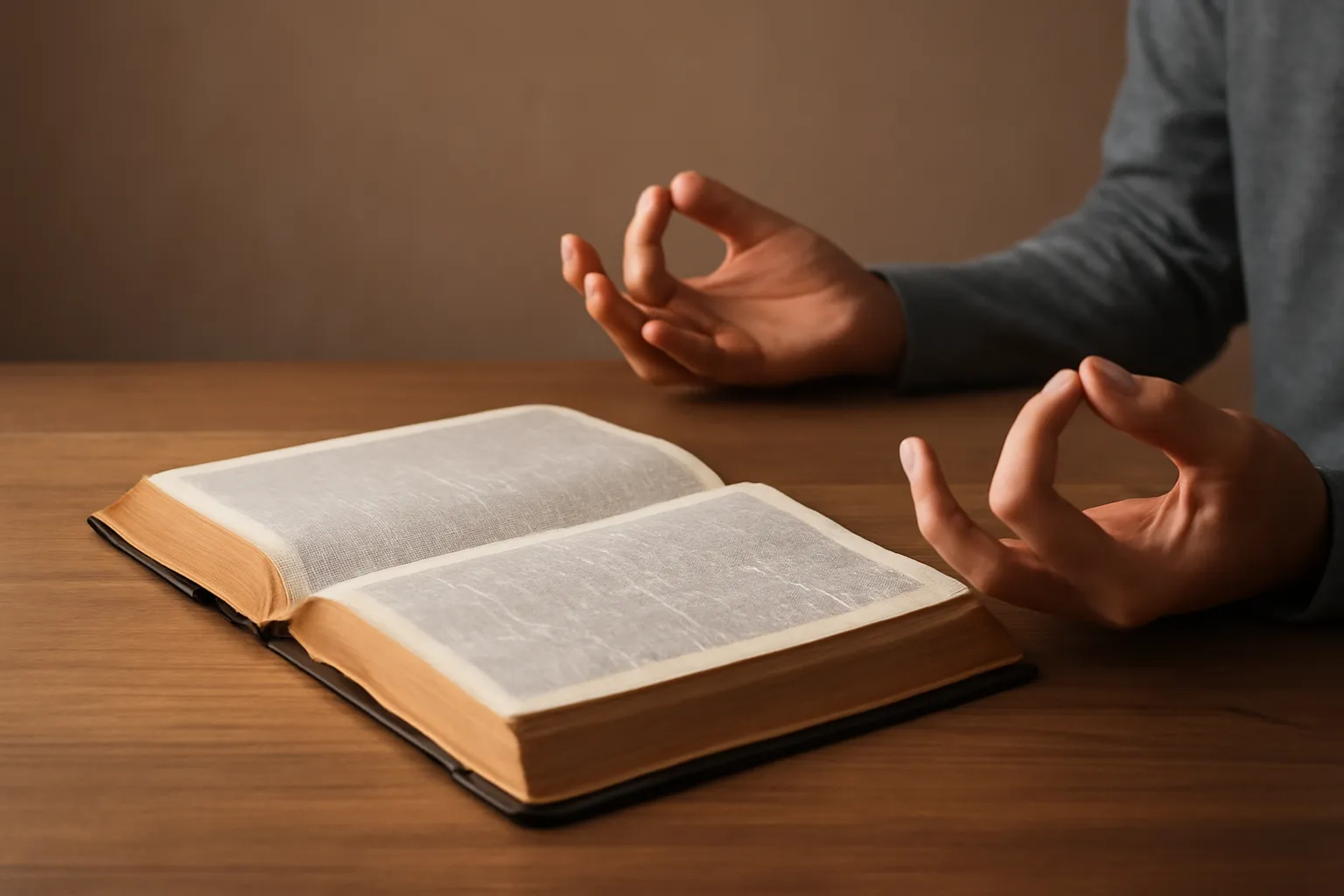
Bible About Meditation is a topic that spans centuries and traditions, inviting readers to explore how Scripture guides the inner life toward God. This article—titled “Bible About Meditation: A Scriptural Guide to Meditation and Prayer”—offers a thorough look at what biblical meditation is, how it has been practiced across the pages of Scripture, and how modern believers can cultivate a steady, Scripturally grounded practice of meditation and prayer. While the term meditation appears in various languages and traditions, the Bible presents a distinctive vision: a form of contemplative attention directed at God, His Word, and His ways. In this guide, you’ll encounter a range of biblical phrases and translations, often expressed as “meditation,” “pondering,” “musing,” or “delight in the law.” The goal is not to drift into nothingness but to align the heart and mind with God’s truth so that life is shaped by His presence and promises.
“Biblical meditation”—or as some prefer to call it, scriptural contemplation—is not a detached or abstract exercise. It is a holy conversation between God and a believer in which the mind is intentionally directed toward God, His character, His Word, and His purposes. In biblical terms, meditation often involves repeated reflection, deliberate focus, and a posture of listening, worship, and obedience. It is not simply quietness but a form of engaged attention that yields spiritual fruit.
In the Scriptures, meditation is closely tied to knowing, obeying, and treasuring God. It is a practice in which the deepest longings of the heart are turned toward the Triune God, so that thoughts, desires, and decisions become increasingly aligned with His will. This makes biblical meditation both deeply personal and communally oriented: it nourishes the individual life and bears fruit in relationships, service, and mission. Throughout this article, you will see how the Bible—often referred to as a “book of life”—encourages a sustained, daily, heart-level engagement with God through mindful attention to His words and ways.
Key Biblical Texts on Meditation
To understand biblical meditation, it helps to survey some core texts that repeatedly describe or imply meditative practice. The following passages come from both the Old Testament and the New Testament and illustrate different facets of meditation: delight, reflection, memorization, and application.
Psalms as a pattern of meditation — The Psalms repeatedly invite the soul to meditate on God’s Word, faithfulness, and creation. For example, Psalm 1:2 says, “But his delight is in the law of the LORD; and in his law doth he meditate day and night.” This verse sets a pattern: the prepared heart finds joy in the Word and dwells there continually.
Psalm 19:14 — “Let the words of my mouth, and the meditation of my heart, be acceptable in thy sight, O LORD, my strength, and my redeemer.” This is a prayer about the content and discipline of meditation: what fills the heart and the mouth should honor God.
Psalm 63:6 — “When I remember thee upon my bed, and meditate on thee in the night watches.” The psalmist links meditation with memory, rest, and nocturnal devotion, illustrating how meditation can shape even the quiet hours.
Psalm 119 (selected verses) — The entire Psalm frames the Word of God as a constant object of meditation: “O how I love thy law! it is my meditation all the day.” (Psalm 119:97). Other verses in this long psalm emphasize hearing, pondering, and treasuring God’s commandments, which is a distinctive form of biblical meditation.
Proverbs 4:20-22 — “My son, attend unto my words; incline thine ear unto my sayings. Let them not depart from thine eyes; keep them in the midst of thine heart.” This passage highlights a practice of turning attention to wisdom, guarding it, and letting it shape daily life.
Philippians 4:8 — “Finally, brethren, whatsoever things are true, whatsoever things are honest, whatsoever things are just, whatsoever things are pure, … think on these things.” While not labeled as meditation in every translation, this verse describes a disciplined mental focus—a form of meditation directed toward virtuous and godly realities.
Colossians 3:16 — “Let the word of Christ dwell in you richly in all wisdom.” Here, the Word is not merely read; it dwells within, shaping thoughts, affections, and decisions—an inward, meditative filling that bears outward fruit.
Luke 5:16 — “And he withdrew himself into the wilderness, and prayed.” The Gospels show Jesus modeling contemplative solitude and prayer, suggesting that meditation often includes silence, listening, and communion with the Father.
1 Thessalonians 5:17 — “Pray without ceasing.” This brief injunction points to a posture of ongoing communion with God, a form of meditative prayer that pervades daily life.
2 Corinthians 10:5 — “Casting down imaginations, and every high thing that exalteth itself against the knowledge of God, and bringing into captivity every thought to the obedience of Christ.” Biblical meditation involves training the mind to align with God’s truth, and actively challenging false or distracting thoughts.
James 1:22-25 — A meditation of the Word is not merely hearing; it is doing. The passage contrasts hearing with practice and exhorts readers to become doers, “not hearers only.”
Across these passages—the bible about meditation in both testaments shows a common aim: to form us more fully into the image of Christ through a life oriented toward God’s Word, in dependence on God through prayer, and in action that flows from that relationship.
Meditation Techniques in the Bible
What did biblical meditation look like in practice? The Bible presents several related approaches that believers have used across generations. While terms vary, the underlying aim is consistent: to fix the heart and mind on God so that life conforms to His will.
Scriptural Contemplation
Focused pondering on a verse — Read a short passage slowly and repeatedly, letting phrases linger in your mind. This form of meditation emphasizes a careful, patient engagement with the text rather than rushing through it.
Ruminating on God’s character — Reflect on attributes such as faithfulness, mercy, justice, and wisdom. The point is to cultivate deeper love and trust by fixing attention on who God is.
Psalm-Saturated Reflection
Let Scripture fill daily life — Meditative practice can include repeating a Psalm aloud or mentally, then allowing its themes to shape choices, motives, and responses to circumstances.
Word-based memorization — Memorizing verses like Psalm 119:105 (“Thy word is a lamp unto my feet, and a light unto my path”) can sustain meditation when you face uncertainty or fatigue.
Be Still and Quietness
Stillness before God — A Biblical form of meditation often includes times of silence before God, recognizing Him as sovereign and listening for His directions. Psalm 46:10 says, “Be still, and know that I am God.”
Solitude in prayer — Jesus’ practice of withdrawing to solitary places (see Luke 5:16) demonstrates how calm reflection and focused praying can accompany a life of mission and service.
Memorization and Recitation
Memorizing key verses — A common biblical practice is to commit short passages to memory and recite them in moments of need, gratitude, or decision. This makes the Word a living presence during daily activities.
Recitation as worship — Speaking God’s truths aloud reinforces belief and invites God’s Spirit to shape the heart as internal reflection becomes outward prayer.
Meditative Prayer
Prayer with reflection — Meditation often accompanies petition and intercession. Reflecting on a verse or attribute can guide the content of prayer and deepen intimacy with God.
Prayerful attention to life — As the mind rests on God, daily life—work, relationships, and calling—becomes an arena for discovering and doing God’s will.
Starting a biblical meditation practice can be simple, but consistency matters. Below is a practical, step-by-step approach designed to be accessible to beginners and adaptable for seasoned practitioners.
Create a quiet, sacred space — Set aside a regular time and place where distractions are minimized. A calm environment helps the mind and heart turn toward God.
Choose a brief, meaningful passage — Select a verse or short passage that resonates, such as a line from the Psalms or a verse that speaks to your current season.
Read slowly and contemplatively — Read the passage several times, listening for a word, phrase, or idea that stands out. Let the Spirit highlight something to you.
Reflect with questions — Ask simple questions such as: What does this text reveal about God? How does this address my heart or responsibilities today? What action might follow this reflection?
Memorize or recite a line — If possible, memorize a short verse or phrase and repeat it in your heart or aloud throughout the day.
Journal and respond — Write a brief reflection, prayer, or a practical step you want to take. This anchors meditation in concrete action.
Pray with the meditation — End with prayer, asking for grace to live in light of what you’ve contemplated and to grow in obedience to God’s will.
Practice consistently — Start with 5–10 minutes, then gradually extend to 15–20 minutes as you grow more comfortable. Regularity matters more than duration at the outset.
In this approach, the practice is not merely about quieting the mind; it is about disciplining the mind toward truth and opening the heart to God so that thoughts, motives, and actions align with His Word.
Biblical Meditation vs Secular Mindfulness
Many people today encounter secular mindfulness and meditation practices that emphasize awareness, nonjudgmental observation, and present-focused calm. The Bible presents a distinct framework for meditation with a particular object and aim: the triune God and His Word. Here are some important distinctions:
Object of focus — Biblical meditation centers on God, His character, and His Word, whereas some secular forms may center on breath or non-specific awareness.
Purpose — The biblical aim is alignment with God’s will, prayer, and obedience; secular mindfulness often emphasizes well-being, stress reduction, or attention training without necessarily addressing God or sin.
Content — Biblical meditation engages Scripture, promises, and worship; secular practices may employ neutral or universal contemplative techniques without a theistic content.
Life transformation — The biblical approach seeks transformation of heart, habits, and justice-oriented living in light of Christ; secular mindfulness may focus more on present experience and emotional regulation.
When incorporating biblical meditation into daily life, many Christians find it effective to hold both aims in harmony: cultivate present-mense stillness before God while filling the mind with Scriptural truths that shape love for God and neighbor. The Bible’s own memory- and heart-centered approach provides a robust framework for life transformation rooted in God’s own revelation.
Common Misconceptions and Questions
As you explore biblical meditation, you may encounter questions or concerns. Here are several common ones, with succinct clarifications grounded in Scripture and Christian tradition:
Is meditation the same as emptying the mind? In biblical meditation, the goal is often filling the mind with God’s truth and letting His Word shape the heart. It is not simply “emptying” the mind, but redirecting thought toward God and His ways (for example, Psalm 104:34; Psalm 19:14).
Can I meditate without biblical content? While any person can practice stillness, the mature form of Christian meditation anchors attention to God’s Word, prayer, and worship. Scripture provides the content that sustains the practice (Philippians 4:8; Colossians 3:16).
Is meditation a replacement for prayer? No. Biblical meditation complements prayer. It strengthens communication with God by guiding the way we listen and respond to Him (Luke 5:16; 1 Thessalonians 5:17).
How long should I meditate? Start with a modest time—5 to 10 minutes—even as you cultivate consistency. Over time, you can extend sessions as your heart grows more settled in God’s presence.
What about contemplative traditions outside the Bible? Christians can engage with contemplative practices if they are anchored in Biblical truth and translated into worshipful, Christ-centered living. Always test practices by Scripture (Acts 17:11; 1 Thessalonians 5:21).
Practical Examples: How Bible-Based Meditation Appears in Life
Real-life applications of scriptural meditation can look variously in families, small groups, and personal devotions. Here are a few concrete illustrations to ground the concept in everyday rhythms:
Morning time with a verse of the day — Begin with a short Scripture passage and a prayer that links the verse to your daily tasks, choices, and attitudes toward others.
Evening reflection on the day — Read a Psalm and reflect on where God showed faithfulness or where you saw your need for grace. Consider what to repent of and what to thank God for.
Family meditations — Parents can guide children through short meditations on a verse, followed by a simple action that embodies the truth (e.g., love, honesty, generosity).
Memorization as a devotional habit — Pick a verse to memorize each week; recite it during commute, chores, or moments of waiting, turning ordinary minutes into worshipful practice.
Quiet before worship services — In preparation for corporate worship, meditate on a short passage to orient the heart toward God, inviting His Spirit to shape what’s sung and preached.
Reflection Verses to Begin or Deepen Your Practice
Consider using one or two of these concise prompts as starting points for your next session. You may choose to recite, reflect, and respond:
“Be still, and know that I am God.” (Psalm 46:10) — A reminder of God’s sovereignty and gentleness in the midst of life’s noise.
“Thy word is a lamp unto my feet, and a light unto my path.” (Psalm 119:105) — A pledge that Scripture guides daily living.
“Let the words of my mouth, and the meditation of my heart, be acceptable in thy sight.” (Psalm 19:14) — A prayer about content and intention.
“Whatsoever things are true… think on these things.” (Philippians 4:8) — A call to channel attention toward truth and virtue.
“My son, attend unto my words; incline thine ear unto my sayings.” (Proverbs 4:20) — A practical invitation to listen and learn from God’s wisdom.
Closing Thoughts: A Scriptural Guide to Meditation and Prayer
In a world crowded with competing voices, the Bible invites believers into a disciplined discipline that centers the heart on God. This Bible About Meditation is not an antiquarian curiosity but a living invitation: to encounter the living God through His Word, to present the mind to Him in trust, and to allow that engagement to transform daily life—thoughts, words, and deeds—to reflect the character of Christ. The Bible teaches that meditation is both a gift and a discipline: a gift in that God Himself draws near when we seek Him; a discipline in that regular, prayerful attention strengthens faith, molds wisdom, and fosters peace in the storm (Isaiah 26:3; Psalm 104:34).
As you explore biblical meditation in greater depth, consider this practical summary: approach Scripture with honest curiosity; listen for the Person behind the text; invite the Spirit to form Christ-like motives; and translate insight into obedience. In this way, scriptural meditation becomes a pathway toward a deeper relationship with God and a more faithful life of prayer. May your journey through the pages of Scripture, and the quiet moments that accompany them, become a rich itinerary of grace—an ongoing opportunity to know God and to love Him with your mind, heart, and hands.