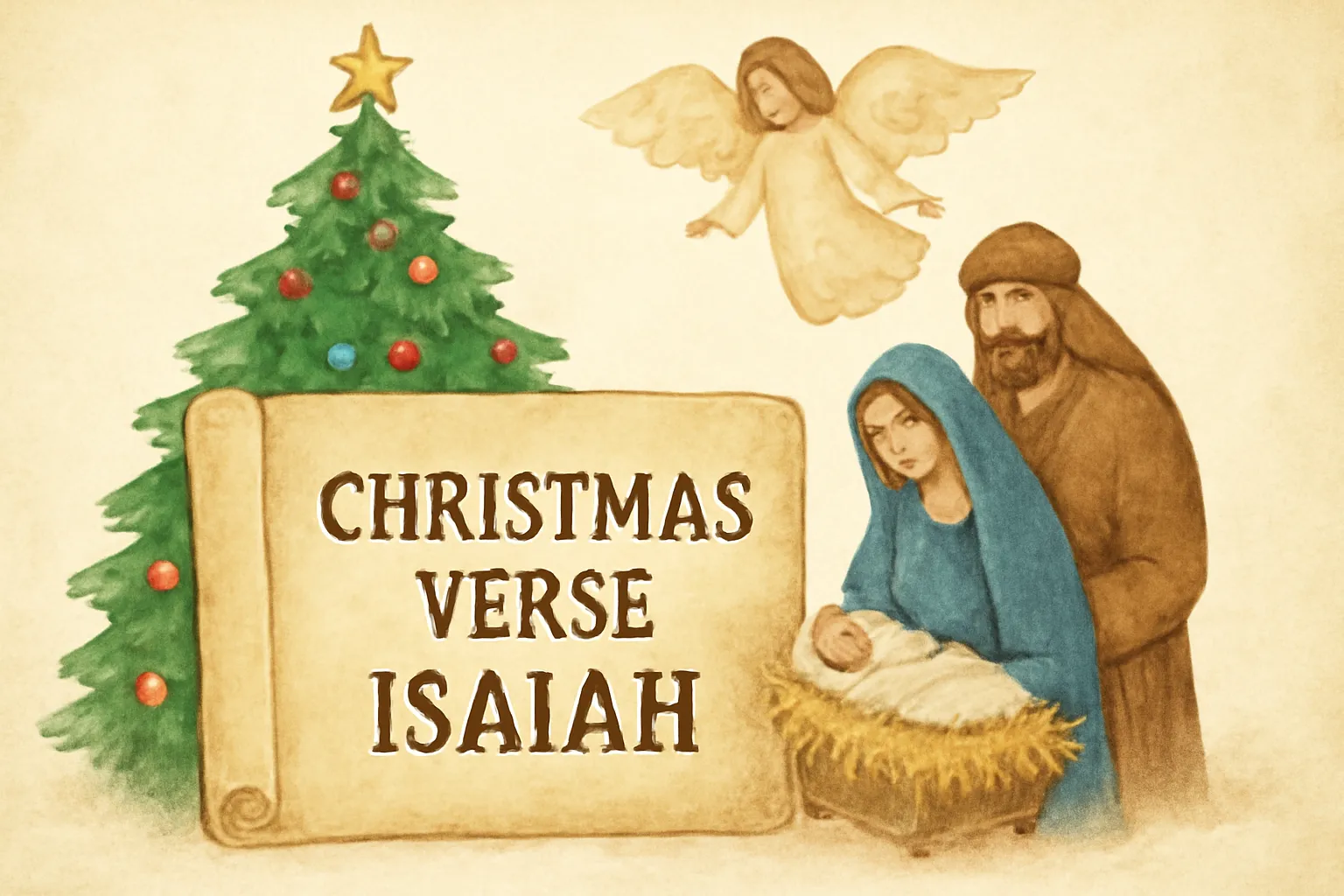
The phrase often described as the “Christmas verse Isaiah” or the prophecies surrounding Isaiah 9:6-7 holds a central place in Christian storytelling about the birth of Jesus. This portion of the Hebrew Bible, nestled in the prophetic book of Isaiah, is frequently cited during Advent and Christmas seasons as a bridge between the old covenant expectations and the New Covenant revelation of the Messiah. In English translations, the verses speak of a child who will be born, a son given, and a government that will rest on his shoulders, with a list of exalted titles that anchor his identity in both kingship and divinity. For many readers, this is not merely a historical statement; it is a theological hinge that connects prophecies of ancient Israel to the person and work of Jesus Christ.
Throughout history, communities have turned to this prophecy behind Christmas to reflect on themes of leadership, peace, justice, and divine intervention in human history. Because the passage intertwines political language (kingly rule, government, throne) with cosmic language (eternity, mighty God, everlasting Father), it offers a rich field for commentary, poetry, hymns, and homiletics. In this article, we will explore the historical setting, the key titles and their meaning, the Christological implications, and the ways in which this Isaiah Christmas verse has shaped worship, art, and personal devotion across cultures.
Historical and Literary Context: Why Isaiah 9:6-7 Matters
To properly appreciate the significance of the Christmas verse Isaiah, it helps to set it within its original context. The book of Isaiah was written in a period of crisis and change for the people of Judah. The prophet spoke into times of political threat from powerful empires, including Assyria, and into moments when the people faced moral and spiritual drift. In this era, the language of judgment and hope sits side by side, and the promise of a future ruler emerges as a beacon of stability and righteousness.
The specific verses of interest, Isaiah 9:6-7, are part of a larger prophecy that carries both a present and a future horizon. On one level, the immediate audience would have recognized the rhetoric of a royal restoration—an expectation that a Davidic king would bring order, justice, and peace to the people. On another level, Christian readers have traditionally interpreted these lines as a prefiguration or a direct reference to Jesus, whose life and ministry would be marked by divine kingship and salvific work.
The public reception of this passage over the centuries has been diverse. Jewish interpreters have read it in the context of a historic Zion heritage and the hopes for national deliverance, sometimes awaiting a human king who would restore national sovereignty. Christian interpreters, by contrast, have often read the passage through the lens of the incarnation—the belief that the eternal Son of God took on human flesh in the birth described at Christmas. Theological discussions around this text thus center on questions about incarnation, divine identity, and the relationship between prophecy and fulfillment.
The Text and Its Core Elements
The King’s titles in this passage are some of the most quoted in Christian liturgy. In traditional English translations, the verses present a string of descriptors that have captivated poets, theologians, and hymn writers alike. The full segment often reads as follows in the King James Version:
For unto us a child is born, unto us a son is given; and the government shall be upon his shoulder: and his name shall be called Wonderful, Counselor, The mighty God, The Everlasting Father, The Prince of Peace.
Of the increase of his government and peace there shall be no end, upon the throne of David, and over his kingdom, to order it, and to establish it with judgment and with justice from henceforth even for ever. The zeal of the Lord of hosts will perform this.
The above rendering captures several layers of meaning that scholars and theologians highlight:
Unto us a child is born and unto us a son is given: A statement about divine action in human history, signaling both sonship and birth as the locus of unfolding divine work.
The government shall be upon his shoulder: A metaphor of kingship and governance, indicating that the ruler’s authority will bear the weight of leadership and national order.
Wonderful, Counselor, Mighty God, Everlasting Father, Prince of Peace: A quartet of titles that together convey wisdom, power, timeless relationship, and transformative peace. Each title has depth beyond a single translation, inviting careful reflection on how the Messiah would be understood in terms of character and mission.
Of the increase of his government and peace there shall be no end: A forward-looking statement about enduring, expanding influence of the ruler’s reign—an eschatological note as well as a present expectation.
The zeal of the Lord of hosts will perform this: A declaration of divine commitment and certainty, grounded in God’s own passionate purpose.
Decoding the Four Titles: What They Convey About the Messiah
The four descriptors that attach to the child-king are central to how the passage is interpreted and celebrated. Each title opens a doorway into a dimension of the Messiah’s identity—dimensions that have influenced Christmas theology, worship, and art throughout the centuries.
Wonderful Counselor: This pairing emphasizes wisdom, guidance, and strategic insight. The term wonderful signals something beyond ordinary wisdom—delightful, astonishing counsel that meets human needs for direction in moral, political, and personal spheres.
Mighty God: A bold claim about divine power and presence. In Christian readings, this title is often read Christologically as a statement of the divinity of the Messiah, who embodies strength and divine action within human history.
Everlasting Father: This is a provocative title, suggesting a fatherly, everlasting origin and care. In Christian theology, it is commonly interpreted as a designation of eternal care and relational leadership that extends beyond time, while some Jewish readers emphasize a more metaphorical fatherly rule within the covenant community.
Prince of Peace: A confidence-creating statement about peace that ends cycles of conflict and establishes harmony. It highlights a transformative peace—personal, communal, and cosmic—that is characteristic of the Messiah’s reign.
When these titles are considered together, they portray a ruler whose character integrates wisdom and power, eternal relationship, and restorative peace. In the context of the Nativity narrative, these traits are not abstract. They inform how believers understand Jesus’ birth: as the moment when God’s ongoing rule begins to touch earth in a tangible, personal way.
Prophecy and Fulfillment: The Intersection of Isaiah 9:6-7 and Christmas
The phrase the prophecy behind Christmas highlights a long-standing interpretive pattern: ancient prophecy is read as foretelling the birth of Jesus, whose life, ministry, death, and resurrection become the fulfillment of the divine promises embedded in Isaiah. This reading has animated countless Christmas carols, sermons, and theological essays. Yet it is important to note the diversity of perspectives:
Christian interpretation: The passage is often taken as a messianic prophecy that points to Jesus, whose birth in Bethlehem inaugurates a kingly and salvific reign that redefines power, justice, and peace.
Jewish interpretation: Some scholars view the passage as referring to a historical king in the Davidic line or as a future ideal of national restoration. The language of divine titles is sometimes read within the covenant framework rather than as a Christological claim.
Messianic expectation in broader traditions: The text offers a template for what a redeemer-king would look like: a ruler who embodies wisdom, divine power, enduring care, and peace. This consensus across traditions is part of why the passage continues to resonate in religious and literary contexts during the Christmas season.
In the Christmas tradition, the Isaiah 9:6-7 prophecy is frequently paired with Gospel narratives in which Jesus is described as fulfilling the law and prophets. The Nativity stories in the Gospels of Matthew and Luke, for many readers, present the incarnation as the moment when God’s long-anticipated plan steps onto the stage of human history. The impact of this linkage is not only theological; it shapes artistic representations, liturgical calendars, and personal devotion throughout the year.
Theological Depth: Incarnation, Trinity, and the Nature of the Messiah
The phrase Mighty God in Isaiah 9:6-7 has sparked robust Christological discussions, particularly about how Christians understand the relationship between the Father, the Son, and the Holy Spirit. The depiction of the Messiah as Mighty God raises questions about how Jesus can be both human (the child born, the son given) and divine (the mighty God) at the same time. This is a classic instance of the mystery of the incarnation: God becoming man, without relinquishing the divine nature, and without ceasing to be God.
The other titles—Wonderful Counselor, Everlasting Father, and Prince of Peace—offer a way to think about the Messiah’s role in the economy of salvation. They point to a figure who leads with wisdom, watches over creation with fatherly care, and brings an enduring, reconciled peace. Theologically, these descriptors invite readers to meditate on:
The harmony of justice and mercy in governance.
The intimate and eternal care God provides for his people.
The transformative peace that surpasses political solutions and addresses the root causes of conflict—alienation, sin, and broken relationships.
In Advent and Christmas preaching, this passage often functions as a reminder that the Christmas story is not only about a baby’s birth but about the dawning of a new form of kingship—one that Gospels interpret as a divine initiative to heal and reconcile all things. The careful reader will recognize that the text invites both humility and awe: a child who is at once vulnerable and powerful, a king who leads not by domination but by blessing, and a plan that is ultimately enacted by God’s own zeal and fidelity.
Worship, Hymns, and the Cultural Impact of the Christmas Verse Isaiah
The echo of Isaiah 9:6-7 can be found across Christian hymnody, sermons, and devotional literature during the Advent season. Many Christmas carols rehearse the same themes of holy kingship, divine guidance, and peaceful governance. While not every hymn directly quotes the four titles, the atmosphere they create—anticipation, reverence, hope—resonates with the prophetic posture of the passages. In visual art and music, the imagery of a child who bears a heavy government on his shoulders has inspired paintings, stained glass windows, and orchestral works that seek to capture the paradox of power and tenderness within the Christmas narrative.
Beyond Christian worship, the texts and motifs from this passage have influenced poetic traditions, literary essays, and interfaith reflections on justice, peace, and leadership. The phrase Prince of Peace has entered popular discourse as a shorthand for reconciliation efforts and humanitarian ideals during the Christmas season and beyond. In classrooms, study groups, and online discussions, the passage serves as a focal point for exploring how ancient prophecies can inform modern ethics and civic imagination.
How to Read and Apply Isaiah 9:6-7 Today
Reading Isaiah 9:6-7 in contemporary life involves both study and reflection. Here are practical ways to engage with the text in personal devotion, teaching, or group discussion:
Study the language: Explore the meanings of the Hebrew terms and their nuances in different translations. Compare the King James Version with more modern renderings to notice shifts in diction and emphasis.
Reflect on the titles: Consider how each title—Wonderful Counselor, Mighty God, Everlasting Father, Prince of Peace—speaks to different aspects of leadership and divine action.
Contextualize historically: Examine Isaiah’s audience, the geopolitical threats of the era, and the hope that the prophecy offered to a people under stress.
Connect with Christmas narratives: See how the Nativity stories illuminate the text’s themes of birth, governance, and peace, and how these themes reappear in carols, sermons, and art.
Apply ethically and pastorally: Use the passage to think about modern governance, social justice, and community peace—how leadership is exercised, who is cared for, and what it means to be a people of hope.
For those teaching this material, a suggested approach might include a brief historical overview, a close reading of the four titles, and then a synthesis that asks: In our own communities, what does it mean to live under the reign of a ruler who embodies wisdom, divine power, eternal care, and peace? The discussion can broaden to practical actions—advocacy for justice, acts of mercy, and commitments to peacebuilding—reflecting the ethical implications of the passage.
Common Questions About the Christmas Verse Isaiah
Here are some frequent questions readers bring to this portion of Scripture, along with concise responses that respect both historical-critical concerns and devotional interpretation:
Is Isaiah 9:6-7 a prophecy about Jesus? Many Christian readers see it as a messianic prophecy that points forward to Jesus, while Jewish readers may interpret the passage as referring to a historical king or a future messianic figure within the covenant framework.
Why are there four titles, and what do they signify? The quartet emphasizes a comprehensive portrait of leadership and divinity—wisdom, power, eternal care, and peace—that together portray the Messiah’s mission to redeem and rule with justice and mercy.
What is the significance of “the government shall be upon his shoulder”? This phrase evokes authority and responsibility. It suggests a ruler who bears the burden of governance and who brings order and stability to the people and the land.
How should we interpret “Everlasting Father”? This title speaks to enduring care and a paternal aspect within the divine plan. It invites reflection on the Messiah’s relationship with God’s people and the nature of eternal faithfulness.
What is the link between this prophecy and Advent worship? Advent expectations of preparation and hope align with the passage’s themes of promised rule, redemptive work, and the dawning of peace through God’s intervention in history.
Concluding Reflections: The Enduring Message of the Christmas Verse Isaiah
The story of Isaiah 9:6-7 invites readers to see Christmas not only as a single event—the birth of a child—but as a moment within a larger drama of salvation, in which God makes a claim on the world through a ruler who embodies wisdom, power, care, and peace. This perspective helps frame Christmas as both a celebration of a historical birth and a meditation on a future hope: that God’s reign, inaugurated in the Incarnation, continues to grow and transform lives, communities, and nations.
Whether approached as a prophecy behind Christmas or as a theological text for contemplation, Isaiah 9:6-7 remains a powerful lens through which to view the mystery of the Incarnation. In the face of today’s challenges—conflict, division, injustice—the passage calls readers to imagine leadership that is just and compassionate, to pursue peace that heals, and to trust in the divine zeal that promises to accomplish what human strength alone cannot achieve. The Christmas season offers a season of invitation: to study, to worship, and to enact the principles embedded in this ancient prophecy so that their fragrance might be felt in ordinary life—at home, in the classroom, in the public square, and in every corner of the world where people yearn for a better king and a lasting peace.